
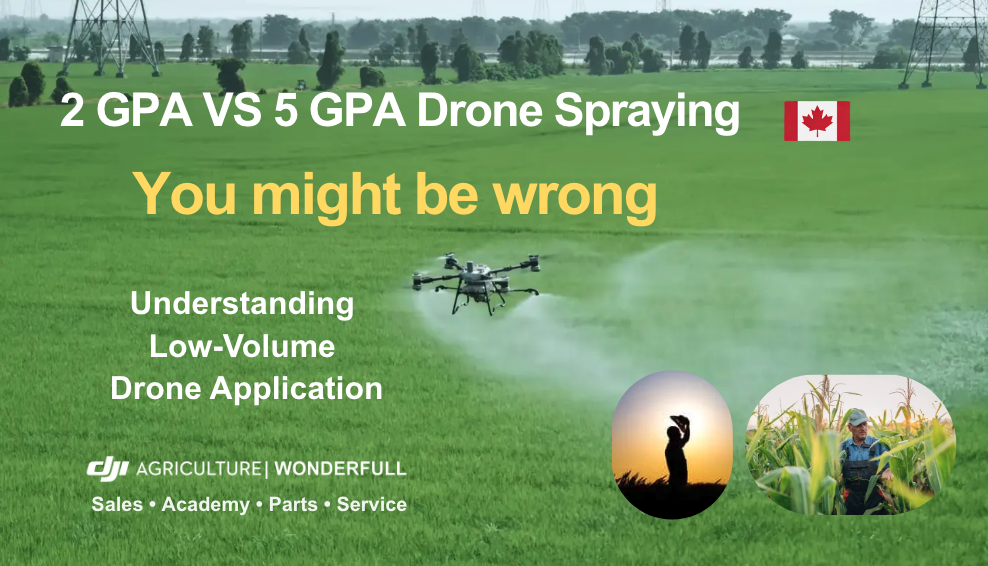
What really works?
In discussions about agricultural drone spraying, we often hear very different opinions.
Some operators say:
“2 GPA works great. We’ve been spraying like that for years.”
Others say:
“Low-volume spraying like 2–3 GPA doesn’t work.”
And some share testing experiences like this:
“We tried 2 GPA and it failed. Only when we switched to 5 GPA did it work.”
All of these perspectives exist in the industry.
So the question naturally comes up:
Should agricultural drones spray at 2 GPA or 5 GPA?
But in many cases, that may actually be the wrong question.
Because in real agricultural applications, spray performance is rarely determined by GPA alone – it is determined by the entire spraying system.
Drone Spraying Is Not a Smaller Version of Ground Sprayers
First, it’s important to understand one key point:
Agricultural drone spraying is not simply a scaled-down version of tractor boom spraying.
Traditional ground sprayers often use much higher carrier volumes, sometimes:
20–50 gallons per acre or more.
Agricultural drones, however, commonly operate using low-volume applications, typically around:
1–3 GPA.
Many people assume this is a new experimental approach introduced by drones.
In reality, it isn’t.
When DJI designed its agricultural drone spray systems, they didn’t simply attach a tank and nozzles to a drone.
The entire spray system was developed by referencing:
-
ground sprayer standards
-
manned aerial application practices
-
extensive real-world spray performance testing
At the same time, engineers conducted:
-
airflow field testing
-
droplet deposition studies
-
rotor airflow optimization
The goal was simple:
to ensure droplets can effectively penetrate the crop canopy and reach the target surfaces where they are needed.
Agricultural Drones Are a System Engineering Product
Before DJI entered the agricultural drone industry, spraying drones already existed in the market.
However, many early systems struggled to operate reliably in real agricultural environments.
Common issues included:
-
unstable structures
-
uneven spray distribution
-
limited endurance
-
unstable video transmission
-
low system reliability
Because of this, DJI invested heavily in system-level engineering for agricultural drones.
For example, earlier platforms such as the T40 and T50 introduced important spray system improvements.
These included:
Dual centrifugal atomizing nozzles
which produce more uniform droplet distribution.
They also introduced solenoid valve control systems.
These valves allow spray nozzles to start and stop in milliseconds, preventing dripping and ensuring precise spray boundaries.
This level of control is extremely important in agriculture.
In many cases, chemical waste or crop damage is not caused by spray volume, but by imprecise spray control
The New Generation Platform: T100 (2026)
In the newest generation of agricultural drone platforms, these engineering systems have been further upgraded.
For example, the 2026 Agras T100.
The spray system uses a:
Magnetic-drive centrifugal pump system
This type of pump offers several advantages in agricultural environments:
-
leak-free design
-
corrosion resistance
-
stable flow output
The system can reach a maximum spray rate of:
40 L/min
At the same time, droplet size can be adjusted depending on crop requirements, typically around:
50–500 μm
Combined with the rotor downwash airflow, this helps droplets penetrate deeper into crop canopies and improves pesticide utilization efficiency.
Precision Positioning System
Another key component of agricultural drones is the positioning system.
The T100 supports:
Multi-constellation GNSS + RTK
with positioning accuracy of approximately:
±10 cm
This level of precision enables:
-
automated flight routes
-
precision spraying
-
consistent repeat operations across fields
Multi-Sensor Safety System
In terms of safety, new-generation agricultural drones use multi-sensor fusion systems.
For example, the Safety System 3.0 includes:
-
millimeter-wave radar
-
LiDAR
-
360° vision systems
Detection distance can reach approximately:
60 meters.
This type of multi-sensor fusion provides significantly better reliability than single-sensor systems, especially in complex agricultural environments such as:
-
orchards
-
hilly terrain
-
fields with power lines.
Agricultural Drones Are Now Aerial Work Platforms
Modern agricultural drones are no longer just spraying machines.
They are increasingly becoming aerial agricultural work platforms.
For example, the T100 supports three main agricultural operations:
-
spraying
-
spreading fertilizer or seed
-
cargo transport
Maximum payload:
100 kg
Agricultural Drones Are High-Cycle Work Systems
Another key component of agricultural drone systems is the energy system.
For example:
DB2160 battery
Capacity:
41,000 mAh
Charging time:
8–9 minutes
(from 30% to 95%)
This design allows agricultural drones to operate as high-cycle working systems, rather than traditional aerial photography drones.
Often the Problem Isn’t 2 GPA
In real operations, we often observe something interesting:
2 GPA itself is rarely the problem.
The real issue is often:
the spray timing window.
For example:
If spraying occurs early in the morning, when temperatures are lower and humidity is higher,
2 GPA may already be sufficient.
However, if spraying is done at midday in hot conditions, evaporation can be very rapid.
In that situation,
even 5 GPA may not be enough.
Spray performance is also affected by many other factors, including:
-
wind conditions
-
crop canopy density
-
flight altitude
-
swath width
-
flight speed
-
row spacing
Because of this, operators often make small adjustments, such as:
-
2.5 GPA
-
3 GPA
-
3.5 GPA
One Key Point Many People Overlook
Whether you spray at 2 GPA or 5 GPA,
the amount of active ingredient applied per acre is usually the same.
What changes is the carrier volume — not the chemical itself.
There are some exceptions.
For example, when spraying:
-
insecticides
-
foliar fertilizers
Because drone spraying uses low-volume, high-concentration application, and rotor airflow helps droplets penetrate the canopy,
in many cases:
chemical usage can be reduced by approximately 30–50%.
The Real Question
In agricultural spraying, many discussions focus on:
2 GPA vs 5 GPA.
But the real issue is something else.
Whether you spray at 2 GPA or 5 GPA,
the amount of active ingredient per acre is usually the same.
What changes is the carrier volume.
What truly determines spray performance is whether the operator understands the entire spraying system.
Finally, I’m curious about your experience.
In your region:
What spray volume works best?
2 GPA?
3 GPA?
or 5 GPA?
In your experience, what spray volume works best in your region — 2 GPA, 3 GPA, or 5 GPA?
These variables interact with each other, and small adjustments can significantly affect spray performance.
Understanding this system is often the difference between trial-and-error spraying and truly professional operations.
This article is part of the Agricultural Drone Knowledge Series.
Prepared by
Wonderfull Inc.
Transport Canada Recognized RPAS Flight School
Certified Advanced Flight Reviewer
Drone Compliance | Academy | Sales | Parts | Service
Office: 647-800-7952
Text 647-287-6851
5955 10 Sideroad
Innisfil, ON L0L 1K0
Canada
Supported by
Canadian Agricultural Drone Advisory Council (CADADC)
cadadc.ca