
applaudingly for Operating Agricultural Drones in Canada
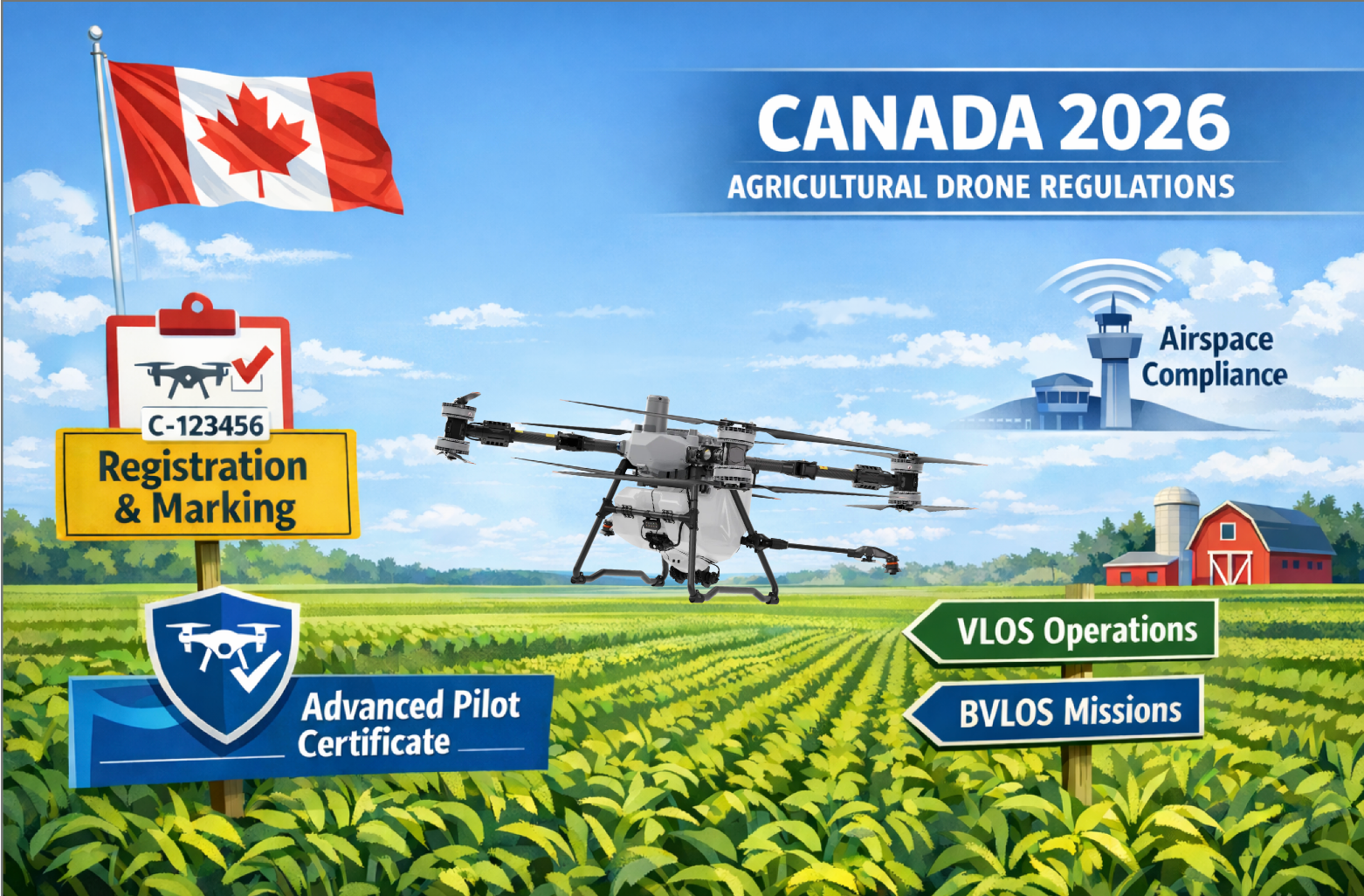
This document summarizes the regulatory requirements for operating agricultural drones in Canada as of 2026, based on Transport Canada’s RPAS regulatory framework and the regulatory changes implemented in 2025.
It is intended for farmers, agricultural drone service providers, training organizations, and commercial operators.
where can i buy disulfiram 1. Drone Weight Categories and Definitions
Transport Canada classifies remotely piloted aircraft systems (RPAS) by weight as follows:
Micro drones
Less than 250 g
Small drones
250 g to 25 kg
Medium drones
More than 25 kg and up to 150 kg
Large drones
More than 150 kg
Most modern agricultural spray drones fall into the medium drone category, with a maximum takeoff weight between 25 kg and 150 kg.
2. Applicability of Canadian Aviation Regulations
All drones are legally considered aircraft under the Canadian Aviation Regulations (CARs).
Operating a drone over private property, including a privately owned farm, does not exempt the operator from federal aviation regulations.
Agricultural drone operations are governed primarily under Part IX of the CARs, unless an operation exceeds the scope of that framework.
3. Drone Registration and Marking
Any drone with a takeoff weight of 250 g or more must be registered with Transport Canada.
This requirement applies to agricultural drones, including medium drones used for spraying or crop monitoring.
Registration is completed through Transport Canada’s Drone Management Portal, and the registration number must be visibly marked on the aircraft.
At present, there is no regulatory exemption that removes the registration requirement for agricultural drones based on their purpose or perceived operational risk.
4. Pilot Certification Requirements
Operating a medium agricultural drone requires an appropriate Transport Canada pilot certificate.
The most relevant certification paths are:
Advanced Pilot Certificate
This is the minimum certification required for most commercial agricultural operations conducted within visual line of sight (VLOS).
Level 1 Complex Operations Certificate
This certification is required for certain low-risk beyond visual line of sight (BVLOS) operations and more complex operational scenarios. It has higher eligibility and training requirements.
Basic Pilot Certificates are not sufficient for operating drones heavier than 25 kg.
5. Visual Line of Sight Operations (VLOS)
As of November 4, 2025, medium drones weighing between 25 kg and 150 kg may be operated within visual line of sight without a Special Flight Operations Certificate (SFOC), provided that:
The pilot holds an Advanced Pilot Certificate or higher
All applicable operational rules are followed
The operation remains within the defined VLOS parameters
This regulatory change significantly reduces administrative barriers for standard agricultural operations such as spraying, seeding, and field inspection.
6. Beyond Visual Line of Sight Operations (BVLOS)
Certain low-risk BVLOS operations are now permitted without an SFOC under the Level 1 Complex Operations framework.
These operations are limited to specific conditions, such as:
Operations in uncontrolled airspace
Flights conducted at or below 400 feet AGL
Operations conducted far from populated areas
Compliance with defined technical, procedural, and safety requirements
BVLOS operations that exceed these predefined low-risk conditions still require an SFOC.
7. Operator and Organizational Compliance
Commercial operators conducting medium or complex agricultural drone operations may be required to obtain an RPAS Operator Certificate (RPOC).
The RPOC framework applies primarily to:
Commercial service providers
Organizations employing multiple pilots
Operators conducting complex or BVLOS operations at scale
The RPOC process is managed through Transport Canada’s Drone Management Portal and focuses on organizational safety systems, procedures, and accountability.
8. Operational Rules and Airspace Limitations
Agricultural drone operations must comply with standard operational limitations, including:
A maximum altitude of 400 feet above ground level unless otherwise authorized
Compliance with controlled and restricted airspace requirements
Avoidance of emergency response areas and advertised public events unless authorized
Adherence to visibility, weather, and safety buffer requirements
Use of visual observers, extended visual line of sight (EVLOS), or sheltered operations is permitted only when all applicable conditions are met.
9. Aircraft and Safety Documentation
Certain medium drone operations require the operator or manufacturer to provide safety declarations or technical documentation demonstrating that the aircraft is suitable for the intended operation.
This may include operational limitations, maintenance records, and risk mitigation measures.
10. Enforcement and Penalties
Failure to comply with Transport Canada drone regulations may result in administrative penalties.
Maximum penalties currently include:
Up to $3,000 for individuals
Up to $15,000 for corporations
Penalties may apply for operating without proper certification, failing to register a drone, violating airspace restrictions, or conducting unauthorized operations.
Summary: 2026 Agricultural Drone Compliance in Canada
For most agricultural drone operations using drones between 25 kg and 150 kg:
- The drone must be registered and marked
- The pilot must hold at least an Advanced Pilot Certificate
- Visual line of sight operations do not require an SFOC
- Low-risk BVLOS operations require Level 1 Complex certification
- More complex or higher-risk operations may still require an SFOC
- Commercial and multi-pilot operations may require an RPAS Operator Certificate
To find a drone school near you:
WONDERFULL INC.
Sales I Academy I Services I Parts
Office: 647 800 7952
Text : 647 287 6851
Address: 5955 10 Sideroad Innisfil, ON L0L 1K0