
If I Fly an Agricultural Drone Only on My Own Farm?
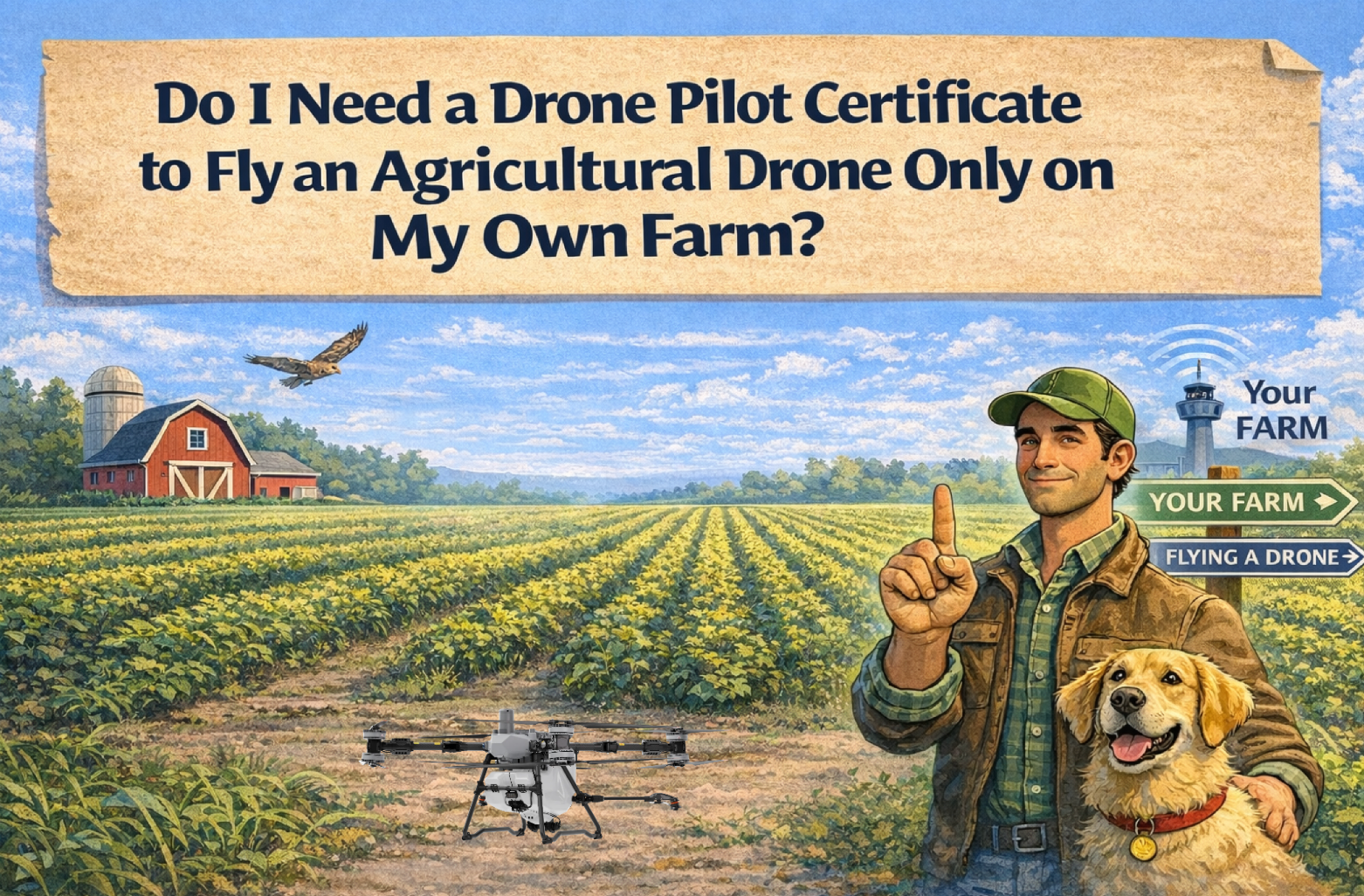
In most cases, yes — you still need a drone pilot certificate.
In Canada, drones are legally classified as aircraft under the Canadian Aviation Regulations (CARs).
This means that drone operations are regulated at the federal level.
Flying only on your own farm does not automatically exempt you from aviation regulations.
Whether a certificate is required depends on the weight of the drone and how it is used, not on who owns the land.
When Is a Drone Pilot Certificate Required?
You must hold a valid Transport Canada drone pilot certificate if any of the following apply:
- The drone weighs 250 g or more
- The drone is used for any agricultural purpose, including spraying, spreading, crop inspection, mapping, or monitoring
- The drone weighs more than 25 kg (which applies to most agricultural spray drones)
- The flight is part of farm operations or commercial agricultural activity, even if you are not charging for services
For agricultural drones weighing between 25 kg and 150 kg, the typical certification requirements are:
- Advanced Pilot Certificate
for visual line-of-sight (VLOS) operations - Level 1 Complex Operations Certificate
for certain low-risk beyond visual line-of-sight (BVLOS) or more complex operations
Basic Pilot Certificates are not sufficient for operating drones over 25 kg.
Why Flying on Private Farm Land Does Not Remove the Requirement
This is one of the most common misunderstandings in agriculture.
In Canada:
- Airspace is regulated federally
- Land ownership does not include ownership of the airspace above it
- Drone operations can still pose risks to:
- Other low-altitude aircraft
- Agricultural helicopters
- Safe farm operations
- Other low-altitude aircraft
As a result:
Transport Canada applies the same pilot qualification requirements on private farmland as it does on public land.
Simply put:
You may own the land,
but you still need to be legally qualified to fly.
Are There Any Situations Where a Certificate Is Not Required?
A pilot certificate is not required only if all of the following are true:
- The drone weighs less than 250 g
- The flight is purely recreational
- The operation does not involve agricultural work or farm production
This exemption does not apply to agricultural spray drones or professional farm operations.
Why Many People Think Agricultural Drones “No Longer Require Certification”
This misunderstanding comes from real regulatory changes — but the conclusion is often wrong.
Transport Canada did make important changes in 2025–2026:
- Reduced reliance on SFOCs for low-risk agricultural operations
- Allowed 25–150 kg agricultural drones to fly legally within VLOS
- Created a formal pathway for low-risk BVLOS operations under Level 1 Complex
However, it is important to understand:
What changed is how you get approval — not who is allowed to fly.
Agriculture is recognized as a lower-risk operating environment,
but that does not eliminate pilot certification requirements.
One-Sentence Summary for Farmers
Flying on your own farm does not remove the requirement for a drone pilot certificate.
Agricultural drone operations are easier to approve than before,
but pilots must still be properly certified.
Or more simply:
Less paperwork to fly.
Certification is still required.
Important Clarification on Registration
Agricultural drones must still be accountable and traceable under Transport Canada’s system.
While the registration and management process for medium drones differs from that of small drones,this does not mean that agricultural drones are unregistered or unregulated.
WONDERFULL INC.
Sales I Academy I Services I Parts
Office: 647 800 7952
Text : 647 287 6851
Address: 5955 10 Sideroad Innisfil, ON L0L 1K0