
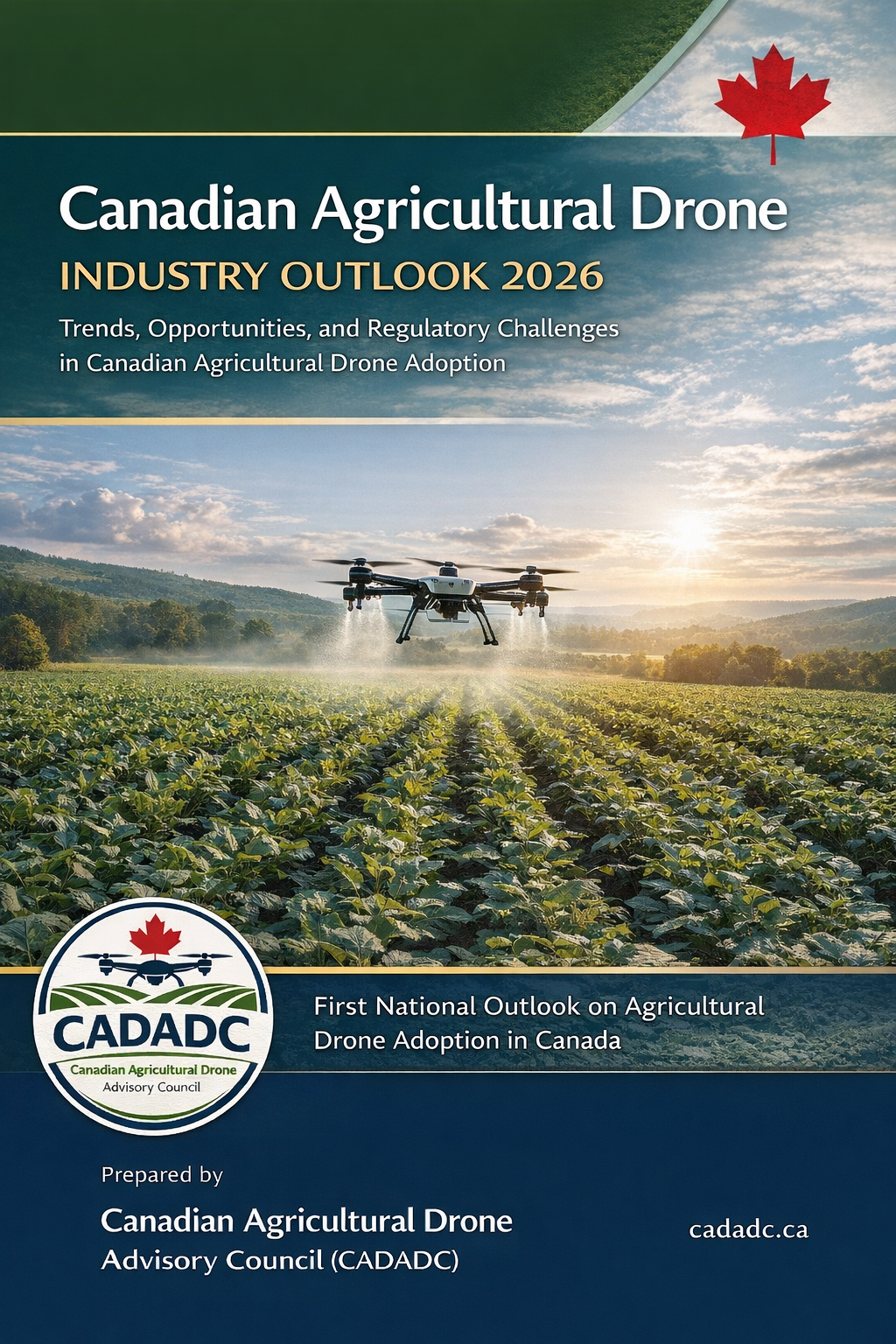
Trends, Opportunities, and Regulatory Challenges in Canadian Agricultural Drone Adoption
Prepared by
Canadian Agricultural Drone Advisory Council (CADADC)
Table of Contents
Executive Summary
- Industry Overview
- Technology Applications
- Economic Benefits for Farmers
- Global Industry Comparison
- Canadian Agricultural Drone Market Estimate (2026–2030)
- Opportunities for Canadian Agriculture
- Regulatory Challenges
- Environmental and Sustainability Impact
- Industry Outlook
- Conclusion
Executive Summary
Drone technology is emerging as a transformative tool for modern agriculture worldwide. Agricultural drones are increasingly used to support crop monitoring, precision spraying, and farm data collection, providing farmers with new tools to improve productivity while reducing environmental impact.
In Canada, agricultural drone adoption is still at an early stage compared with leading markets such as China, Japan, and the United States. However, interest among farmers, agricultural service providers, and technology companies is growing rapidly.
This report provides an overview of the current state of agricultural drone adoption in Canada, explores key technological applications, and examines the potential economic benefits for Canadian farms. The report also identifies regulatory and operational challenges that may influence the pace of industry development.
The Canadian Agricultural Drone Advisory Council (CADADC) believes that collaboration between farmers, researchers, drone operators, technology providers, and regulators will be essential to support the responsible growth of this emerging sector.
This report represents the Querecotillo first national outlook on agricultural drone adoption in Canada.
1 Industry Overview
Agricultural drones are increasingly recognized as a valuable tool within modern precision agriculture systems.
Globally, drones are used for a wide range of agricultural applications including crop monitoring, aerial mapping, precision spraying, and field analysis. These technologies allow farmers to collect detailed information about crop conditions and apply inputs more efficiently.
In Canada, agricultural drone adoption remains at an early stage but interest is growing steadily.
Several factors are driving this interest:
- labour shortages in agriculture
- increasing costs of agricultural inputs
- growing demand for sustainable farming practices
- rapid advances in drone and sensor technology
In recent years, drone service providers have begun to emerge across Canada, offering crop monitoring and spraying services to farmers who prefer not to operate drones themselves.
Despite this momentum, Canada’s agricultural drone industry remains relatively small compared with international markets.
2 Technology Applications
Agricultural drones can support a wide range of farming activities. The most common applications include crop monitoring, precision spraying, and field mapping.
Crop Monitoring
Drones equipped with high-resolution cameras allow farmers to observe crop conditions more frequently and with greater detail than traditional aerial imagery.
Typical uses include:
- detecting pest damage
- identifying nutrient stress
- monitoring crop emergence and growth
Frequent aerial observation enables farmers to identify potential issues earlier and make more informed management decisions.
Precision Spraying
Drone spraying systems enable targeted crop protection applications.
Potential benefits include:
- reduced soil compaction
- improved spray coverage in tall or dense crops
- ability to treat localized problem areas
Drone spraying may be particularly useful in situations where ground equipment cannot easily access fields.
Field Mapping and Data Collection
Drones can generate high-resolution aerial maps that support precision agriculture.
These maps can assist with:
- crop stand assessment
- drainage evaluation
- field variability analysis
Such information helps farmers optimize input use and improve crop management strategies.
3 Economic Benefits for Farmers
Agricultural drones offer several potential economic advantages for farmers.
Early Detection of Crop Issues
Early detection of pests, diseases, or nutrient deficiencies allows farmers to respond more quickly and prevent potential yield losses.
Reduced Input Costs
Targeted spraying methods may reduce unnecessary chemical applications, potentially lowering crop protection costs.
Reduced Soil Compaction
Because drones operate from the air, they avoid the soil compaction associated with heavy ground equipment.
Operational Flexibility
Drones can operate in field conditions where traditional machinery may not be suitable, such as wet soil conditions or late-stage crop growth.
In addition, the emergence of agricultural drone service providers allows farmers to access drone technology without purchasing equipment themselves.
4 Global Industry Comparison
Several countries have already adopted agricultural drone technology at large scale.
China
China has the world’s largest agricultural drone market, with hundreds of thousands of drones used for crop spraying and monitoring. Strong domestic manufacturing and government support have accelerated adoption.
Japan
Japan has used aerial crop spraying systems for decades, originally using unmanned helicopters and more recently transitioning to drone technology.
United States
In the United States, agricultural drone adoption is growing rapidly. Specialized service providers and evolving regulatory frameworks have supported industry development.
These international examples demonstrate that agricultural drone adoption can scale rapidly when supported by clear regulations, operator training, and industry collaboration.
Compared with these countries, Canada’s agricultural drone sector remains at an early stage but has strong long-term potential.
5 Canadian Agricultural Drone Market Estimate (2026–2030)
Current Market Situation
Agricultural drone adoption in Canada is still developing, but interest among farmers and agricultural service providers continues to grow.
Based on global market trends and current industry activity, the Canadian agricultural drone sector is expected to expand significantly over the next decade.
Estimated Market Size
Estimated number of agricultural drones in Canada:
| Year | Estimated Units | Market Value |
|---|---|---|
| 2026 | 800–1,200 | $40–60M |
| 2027 | 1,500–2,000 | $70–90M |
| 2028 | 2,500–3,500 | $120–150M |
| 2029 | 4,000–5,500 | $200–260M |
| 2030 | 6,000–8,000 | $320–400M |
These estimates include:
- agricultural spraying drones
- crop monitoring drones
- supporting services and software
Key Growth Drivers
Several factors are expected to drive industry growth:
Labour Shortages
Canadian agriculture continues to face labour shortages, increasing interest in automation and digital technologies.
Precision Agriculture Adoption
Farmers are increasingly adopting technologies that improve input efficiency and crop management.
Technology Improvements
Advances in drone battery capacity, automation, and spraying systems are making agricultural drones more practical for commercial use.
Service Provider Expansion
Many farmers prefer to hire drone service providers rather than operate drones themselves, creating a new agricultural service industry.
6 Opportunities for Canadian Agriculture
Drone technology may offer particular benefits for certain Canadian crop sectors.
Potential applications include:
- specialty crops
- vineyards
- orchards
- potato production
- vegetable production
These crops often require targeted crop protection and may benefit from more precise spraying methods.
Drone services may also be particularly valuable in regions where labour shortages present operational challenges.
7 Regulatory Challenges
Despite the potential benefits, several regulatory challenges remain.
Aviation Regulations
Drone operations in Canada must comply with Transport Canada regulations governing remotely piloted aircraft systems (RPAS).
These regulations include requirements related to pilot certification, operational limits, and airspace restrictions.
Crop Protection Product Labels
One of the most significant challenges for agricultural drone spraying is the limited number of crop protection product labels that explicitly authorize drone application.
Clear regulatory guidance will be important to support safe and compliant drone spraying operations.
Industry Standards
As the agricultural drone industry develops, standardized operating procedures will become increasingly important.
Areas that may benefit from further industry collaboration include:
- operator training standards
- spraying calibration methods
- environmental protection practices
Continued collaboration between regulators, industry participants, and research institutions will be essential to develop safe and practical frameworks for agricultural drone operations in Canada.
8 Environmental and Sustainability Impact
Agricultural drones may contribute to improved environmental outcomes by enabling more precise application of crop protection products.
Potential environmental benefits include:
- reduced off-target spray drift
- lower chemical usage through targeted application
- reduced soil compaction from heavy machinery
As sustainability becomes an increasingly important priority in agriculture, drone technology may play a role in supporting more environmentally responsible farming practices.
9 Industry Outlook
Agricultural drone adoption in Canada is expected to increase steadily over the coming years.
Key factors likely to influence industry growth include:
- continued advances in drone technology
- development of specialized agricultural drone systems
- improvements in regulatory frameworks
- increasing farmer awareness of drone applications
As precision agriculture continues to evolve, drones may become an important component of modern farm management.
Organizations such as the Canadian Agricultural Drone Advisory Council (CADADC) can help facilitate knowledge sharing, industry dialogue, and responsible innovation across the sector.
10 Conclusion
Agricultural drones represent a promising technology for Canadian agriculture.
Although the industry is still developing, the potential benefits for productivity, efficiency, and sustainability are significant.
With continued collaboration between farmers, researchers, technology providers, and regulators, agricultural drones may become an increasingly valuable tool for Canadian farms in the coming years.
The Canadian Agricultural Drone Advisory Council (CADADC) will continue to support responsible innovation, industry dialogue, and knowledge sharing to help guide the future development of this emerging sector.
Prepared by
Canadian Agricultural Drone Advisory Council (CADADC)
cadadc.ca