
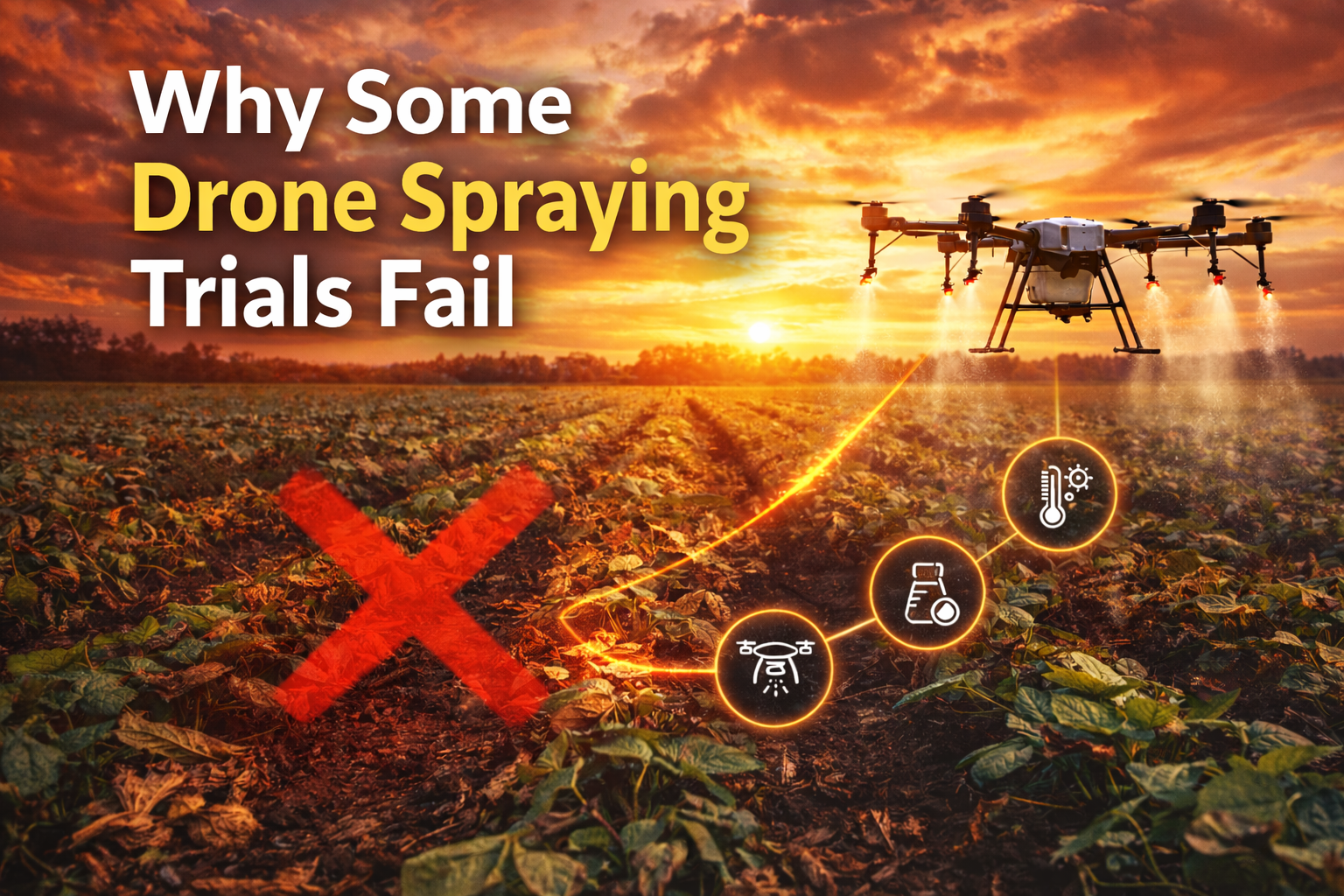
As agricultural drone technology continues to develop in Canada, more farmers, researchers, and service providers are beginning to test drone spraying in real field conditions.
These early trials are important for the growth of the industry. However, it is not uncommon to hear that some drone spraying tests produced inconsistent or unsatisfactory results.
When this happens, the conclusion is sometimes that the technology itself does not work.
In reality, most unsuccessful trials are not caused by the drone itself. They are usually related to how the spraying system was applied.
Agricultural drone spraying is a specialized application system, and several key factors must work together for successful results.
1. Environmental Conditions Were Not Suitable
Low-volume drone spraying is highly sensitive to environmental conditions.
Key factors include:
• temperature
• humidity
• wind speed
• time of day
High temperatures and low humidity can cause spray droplets to evaporate before reaching the crop canopy. Strong or unstable winds can also affect spray distribution.
In many successful drone operations around the world, spraying is commonly performed during early morning or late afternoon, when environmental conditions are more stable.
If a trial is conducted under unfavorable weather conditions, the results may not reflect the true potential of the technology.
2. Spray Concentration Was Not Adjusted
Drone spraying typically uses much lower carrier volumes than traditional ground sprayers.
Because of this, the chemical concentration in the spray mixture must be adjusted accordingly.
If the same mixing approach used for boom sprayers is applied directly to drone spraying, the effective amount of active ingredient reaching the crop may be too low.
This is one of the most common reasons early trials produce poor results.
3. Flight Parameters Were Not Optimized
Drone spraying performance depends on several flight parameters working together.
These include:
• flight altitude
• flight speed
• swath width
• nozzle selection
Small changes in these settings can significantly influence spray coverage and canopy penetration.
Operators with limited experience may unintentionally use flight settings that reduce spray effectiveness.
4. The Downwash Effect Was Not Considered
One of the major advantages of agricultural drones is the rotor downwash created by the propellers.
This downward airflow can help droplets penetrate dense crop canopies.
However, the effectiveness of downwash depends on:
• flight altitude
• crop height
• canopy density
If the drone is flown too high or too fast, the benefit of downwash can be reduced.
Drone Spraying Is a System
One of the most important things to understand is that drone spraying is not just about the drone.
It is a complete application system that involves:
• environmental awareness
• spray chemistry
• droplet control
• flight operation
Even the most advanced equipment cannot produce consistent results without the right operating knowledge.
Learning Curve of a New Technology
Agricultural drone spraying is still relatively new in many parts of Canada.
As with any emerging technology, early trials often involve experimentation and learning.
Many experienced operators around the world will say that the biggest challenge is not flying the drone — it is understanding how all the spraying variables work together.
As knowledge and training improve, trial results tend to become more consistent and reliable.
Moving Forward
The growth of agricultural drone technology will depend on continued testing, knowledge sharing, and operator training.
Understanding why certain trials fail is an important step toward building better practices for the future.
As more experience is gained, drone spraying will continue to evolve into a reliable and valuable tool for modern agriculture.
Professional operations are rarely built on guesswork. They are built on knowledge, experience, and discipline.
This article is part of the Agricultural Drone Knowledge Series.
Prepared by
Canadian Agricultural Drone Advisory Council (CADADC)
cadadc.ca