
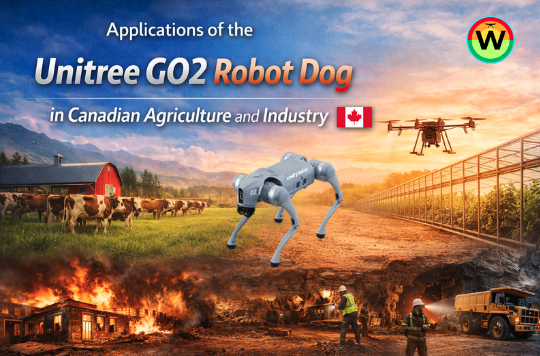
As one of the fastest-growing and most cost-effective quadruped robotics companies in the world, Unitree Robotics will be showcasing its GO2 robot dog at our upcoming Canadian AgTech event.
As intelligent technologies continue to evolve, quadruped robots—commonly known as robot dogs—are moving from research labs into real-world applications. Unlike traditional equipment, their value lies not in replacing machinery, but in performing inspection, data collection, and risk-intensive tasks.
For many agricultural users, a natural question arises: if we already have traditional tools—or even real guard dogs—what practical value does a robot dog bring?
This article explores the real-world applications of robot dogs in agriculture and industry.
1. Core Positioning of Robot Dogs
A robot dog is not a piece of agricultural machinery. It is best understood as a mobile inspection and data collection platform.
Its core function can be summarized as:
Entering hazardous environments, performing repetitive tasks, and continuously collecting and transmitting data.
2. Greenhouses: The Most Promising Agricultural Use Case
Among agricultural applications, greenhouses represent one of the most practical and scalable environments for robot dogs.
In greenhouse settings, a robot dog can:
- Monitor temperature, humidity, and CO₂ levels on a regular schedule
- Capture crop growth data along predefined routes
- Identify anomalies such as disease or uneven growth
- Perform high-frequency, standardized inspections
Greenhouses are particularly suitable because:
- Ground conditions are stable and predictable
- The environment is enclosed and structured
- Inspection routes can be repeated consistently
- Manual monitoring requires ongoing labor
In this context, a robot dog serves as a reliable, long-term inspection solution that improves data consistency while reducing labor dependency.
It can be thought of as an automated greenhouse inspector and data collector.
3. Livestock Farming: An Underrated but Strong Fit
Compared to crop farming, robot dogs are often even better suited for livestock operations.
In ranches and livestock facilities, they can:
- Monitor the condition and movement of animals
- Provide remote visibility for issues such as injury or straying
- Conduct night patrols, reducing the need for manual checks
- Trigger alerts when anomalies are detected
These tasks are repetitive, time-sensitive, and often require 24/7 coverage.
In this setting, a robot dog offers continuous, reliable monitoring and can significantly reduce manual workload.
It functions as a tireless ranch patrol assistant.
4. Mining and Industrial Applications: The Most Mature Use Case
Robot dogs are already widely adopted in mining and industrial environments.
Typical applications include:
- Entering hazardous zones with risks such as collapse or toxic gases
- Inspecting equipment in high-temperature or dusty environments
- Performing automated patrols with real-time data transmission
- Replacing human workers in high-risk inspection tasks
In these environments, the value is clear: improved safety and reduced human exposure to risk.
5. Firefighting and Emergency Response: A Critical Safety Tool
Beyond industrial use, robot dogs are increasingly valuable in firefighting and emergency response scenarios.
They can:
- Enter burning buildings or unstable structures for reconnaissance
- Operate in toxic or oxygen-deficient environments
- Provide real-time video and environmental data
- Assist in locating survivors in disaster zones
Emergency environments are unpredictable and dangerous. Robot dogs can be deployed first to gather critical information, helping responders make safer and more informed decisions.
In these cases, their value goes beyond efficiency—it directly contributes to saving lives.
6. Why Not Just Use a Real Dog?
A common question from agricultural users is: if we already have guard dogs or manual inspection routines, why use a robot dog?
The difference lies in capability:
A real dog can observe, but it cannot record, transmit, or analyze data.
A robot dog not only “sees,” but also documents, streams, and integrates data into decision-making systems.
In other words, it provides traceable, actionable insights—not just presence.
Conclusion
Robot dogs are not just another piece of equipment—they fill a critical gap in both agriculture and industry: consistent, standardized, and low-risk inspection and data collection.
They are best understood as intelligent inspection robots—not traditional farm equipment.
In the right applications, they are not a novelty, but a practical tool that enhances both operational efficiency and safety.
Interested in seeing it live?
Our demo space is limited—register in advance to secure your spot.
https://www.wonderfull.ca/canada-agtech-field-show-2026/
Prepared by
Wonderfull Inc.
Transport Canada Recognized RPAS Flight School
Certified Advanced Flight Reviewer
Drone Compliance | Academy | Sales | Parts | Service
Office: 647-800-7952
Text 647-287-6851
5955 10 Sideroad
Innisfil, ON L0L 1K0
Canada
Supported by
Canadian Agricultural Drone Council (CADADC)
cadadc.ca