
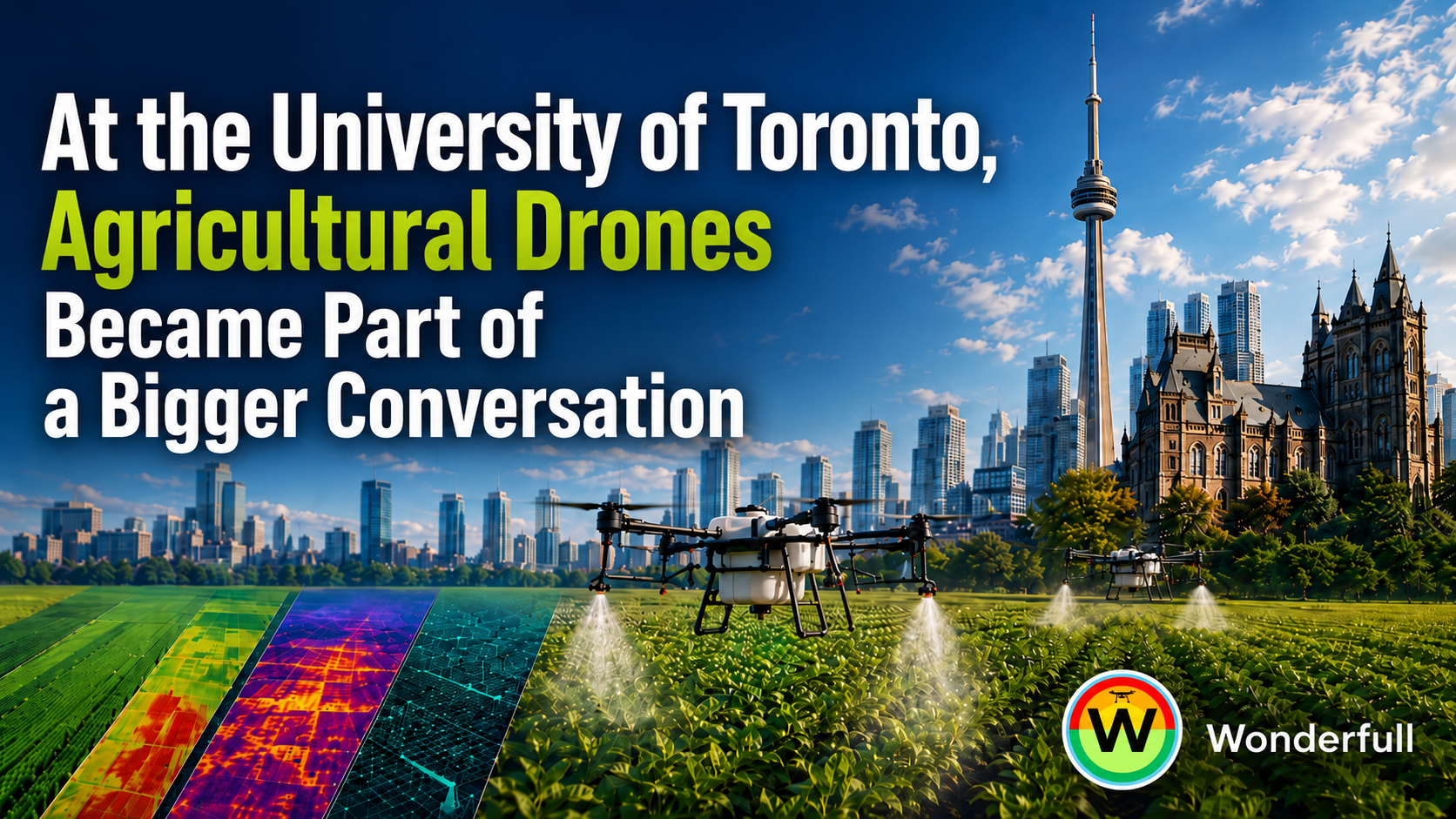
Today, we were invited to participate in an event at the University of Toronto Engineering Innovation Hub. The room was filled with professors, researchers, and industry professionals from across Canada working in AI, robotics, ag-tech, plant science, plant breeding, Greenbelt initiatives, conservation, and environmental research.
It did not feel like a traditional agriculture expo.
It felt more like a discussion about the future of intelligent systems, ecological management, and how AI will eventually interact with the real world.
The conversations ranged from autonomous robotics, AI perception, and machine vision, to digital twins, sensor fusion, environmental modeling, automated systems, and how advanced technologies can operate reliably outside controlled laboratory environments.
And agriculture, perhaps surprisingly, sits at the center of one of the most difficult and most important real-world environments for all of these technologies.
At the event, we brought the DJI Agras T100 agricultural drone platform along with multispectral and thermal imaging systems for demonstration. One thing quickly became clear during discussions with researchers and engineers:
The most interesting thing about agricultural drones may not actually be spraying.
Instead, they are gradually becoming:
- Mobile ecological sensing platforms
- Autonomous low-altitude robotic systems
- Data infrastructure for agricultural AI
- A bridge between agriculture, ecology, and intelligent decision-making
And that raises a very interesting question for Canada’s AI and robotics community:
Could agriculture become one of the most important real-world training grounds for next-generation embodied AI?
The Greatest Value of Drones May Be Their Ability to See What Humans Cannot
Traditional agriculture has long relied on experience.
Farmers walk through fields observing:
- Leaf coloration
- Crop vigor
- Soil conditions
- Pest pressure
- Uneven growth patterns
But human observation has limits.
Modern agriculture often does not lack machinery.
What it lacks is:
High-frequency, scalable, measurable environmental data collection.
This is where multispectral and thermal imaging systems begin to fundamentally change agriculture.
Multispectral Imaging: Letting Plants “Speak”
Many people assume multispectral imaging is simply “better photography.”
It is not.
Plants naturally reflect light differently across various wavelengths.
And these spectral changes often appear days or even weeks before visible symptoms such as yellowing, wilting, or yield loss become noticeable.
Using multispectral systems, we can analyze:
- Crop health (NDVI / NDRE)
- Nitrogen uptake
- Photosynthetic efficiency
- Water stress
- Early disease development
- Soil variability
- Growth uniformity
- Differences between plant varieties under real environmental conditions
For plant science and breeding research, this is especially important.
Traditionally, breeding programs required researchers to manually inspect and record plants one by one in the field.
Now, drones can:
- Collect data across much larger areas
- Perform high-frequency monitoring
- Build long-term growth datasets
- Analyze genotype responses to environmental stress
This means future plant breeding may increasingly rely not only on human expertise, but also on AI-driven analysis of large-scale biological and environmental datasets.
And perhaps more importantly:
AI may eventually identify biological patterns that humans were never able to observe directly.
Thermal Imaging May Be One of the Most Underrated Technologies in Agriculture and Ecology
When many people think of thermal imaging, they think of:
- Firefighting
- Search and rescue
- Night vision
But agriculture and ecological monitoring may ultimately become some of the most important long-term applications for thermal sensing.
Because plants generate heat.
And changes in plant temperature often indicate:
- Water stress
- Abnormal transpiration
- Root system issues
- Early disease infection
- Irrigation inconsistency
- Environmental stress
In many cases, plants may still appear visually healthy while thermal imaging already reveals underlying problems.
This changes the entire logic of agricultural management.
Previously:
Problems were treated after they became visible.
Increasingly:
Problems may be predicted before they become visible.
And prediction is exactly where AI excels.
Drones Are Not Just Agricultural Tools — They May Become Ecological Infrastructure
Many attendees at today’s event were also involved in Greenbelt and conservation-related research.
This led to another fascinating discussion:
Agricultural drones may not only serve farming.
They may increasingly become part of ecological management systems.
For example, drones can support:
- Wetland monitoring
- Vegetation change analysis
- Invasive species tracking
- Forest health assessment
- Long-term ecological modeling
- Low-disturbance environmental surveying
Historically, many ecological studies required:
- Researchers physically entering sensitive areas
- Expensive helicopter operations
- Long periods of manual observation
Now, intelligent low-altitude systems can perform many of these tasks more frequently, more safely, and at significantly lower cost.
More importantly:
They continuously generate real-world ecological data.
And real-world data is precisely what modern AI systems still lack.
Agriculture and Conservation May Not Actually Be Opposites
One of the most interesting themes discussed today was the relationship between agriculture and environmental protection.
Historically, these have often been framed as opposing forces:
Agricultural expansion vs. ecological preservation.
But advanced agriculture may eventually support conservation rather than conflict with it.
Because the core philosophy behind precision agriculture is actually very simple:
Apply the right resource, only where it is truly needed.
That means:
- More precise spraying
- More targeted fertilization
- Reduced chemical waste
- Lower soil compaction
- Reduced water usage
- Less disruption to sensitive ecosystems
In other words:
As agricultural technology becomes more advanced, farming may not move further away from nature.
It may instead become better at understanding ecosystems, environmental balance, and the land itself.
The DJI Agras T100 Is Interesting Not Because It Is Large — But Because of What It Represents
Many people seeing the DJI Agras T100 for the first time are impressed by its size and efficiency.
But its true significance is not simply that it sprays quickly.
It is that platforms like this are evolving into:
Large-Scale Autonomous Outdoor Robotics Systems
The system integrates:
- RTK high-precision positioning
- Autonomous route planning
- Terrain following
- Obstacle sensing
- Multi-sensor fusion
- Autonomous operational logic
- Variable-rate application capability
- Orchard and complex terrain modes
- High-efficiency payload systems
From a robotics perspective, this is already a highly mature autonomous outdoor platform.
And agriculture happens to be one of the most difficult robotic environments in the real world.
Unlike factories:
- Terrain constantly changes
- Wind conditions are unstable
- Biological systems are unpredictable
- Lighting conditions shift continuously
- Humidity varies dramatically
- GPS conditions are not always ideal
- Crops themselves are dynamic living systems
Which means:
If a robotic platform can operate reliably in agriculture, it has already achieved a remarkably high level of real-world autonomy.
And interestingly, many of these capabilities are already mature within DJI’s enterprise ecosystem.
Today, DJI industrial platforms are already widely used in:
- Powerline inspection
- Forestry operations
- Fire hotspot monitoring
- Search and rescue
- Firefighting
- 3D modeling
- Surveying and mapping
- Infrastructure inspection
- Environmental research
- Disaster assessment
So perhaps the truly interesting thing about agricultural drones is not that they are “becoming intelligent.”
It is that:
Industrial-grade autonomous robotics systems are now entering agriculture and ecological systems at scale.
And that may represent one of the most important technological shifts happening today.
Because agriculture has historically been one of the least digitized large-scale industries in the world.
But now:
- AI is entering agriculture
- Machine vision is entering agriculture
- Autonomous decision-making is entering agriculture
- Real-time environmental sensing is entering agriculture
- Multi-sensor fusion is entering agriculture
For the first time, agriculture is becoming:
One of the Core Real-World Environments for Human–Robot–AI Interaction
Canada May Be One of the Best Testing Grounds for Agricultural and Ecological Robotics
Canada possesses:
- Massive agricultural operations
- Large-scale forests and wetlands
- Extensive ecological protection systems
- Greenbelt infrastructure
- Low population density
- Severe labor shortages
- Extreme climate variability
- Strong academic research institutions
Which makes it an ideal environment for:
- AI-driven agricultural systems
- Autonomous agricultural robotics
- Ecological monitoring platforms
- Digital agriculture
- Environmental AI modeling
- Low-altitude intelligent infrastructure
Especially as AI advances rapidly, agriculture and ecology may become some of the most important real-world AI environments in Canada.
The Most Important Question May Be This:
Could Agriculture Help AI Truly Understand the Physical World?
Most modern AI systems are still trained primarily on internet data.
But real-world environmental data remains extremely limited.
Agriculture and ecological systems, however, contain:
- Long-term environmental change
- Massive real-world complexity
- Dynamic environmental interactions
- Large-scale visual and thermal information
- Continuous feedback loops
- Clear real-world outcomes
This is almost an ideal embodied AI environment.
Which means agriculture may not simply become a user of AI.
It may become one of the places where AI finally learns to understand reality itself.
The Greatest Long-Term Impact of Drones May Not Be Replacing Humans
But Helping Humans Understand the Land More Deeply
Today, many people still see agricultural drones simply as:
“More advanced spraying tools.”
But perhaps ten years from now, we will realize they changed something much larger:
- How humans observe agriculture
- How AI understands ecosystems
- How plant science is conducted
- How breeding data is collected
- How farms are managed
- How conservation is performed
- How automation interacts with natural systems
And this may only be the beginning.
Prepared by
Wonderfull Inc.
Transport Canada Recognized RPAS Flight School
Certified Advanced Flight Reviewer
Drone Compliance | DJI Academy | Sales | Parts | Service
Office: 647-800-7952
Text: 647-287-6851
5955 10 Sideroad
Innisfil, ON L0L 1K0
Canada