
Over the years, one question has come up again and again in conversations with farmers:
“Should I hire a drone service provider, or would it make more sense to buy my own agricultural drone?”
Most people instinctively reach for a calculator when they start thinking about the answer.
On one side is the cost of purchasing a drone. On the other is the cost of hiring a service provider and paying on a per-acre basis. From there, the discussion usually turns into a comparison of acres, costs, and payback periods.
How many acres would it take to justify ownership?
How many seasons would it take for the equipment to pay for itself?
Which option costs less over time?
Those are reasonable questions, and they certainly deserve consideration. However, if the decision is based entirely on those numbers, there is a good chance the most important part of the equation will be overlooked.
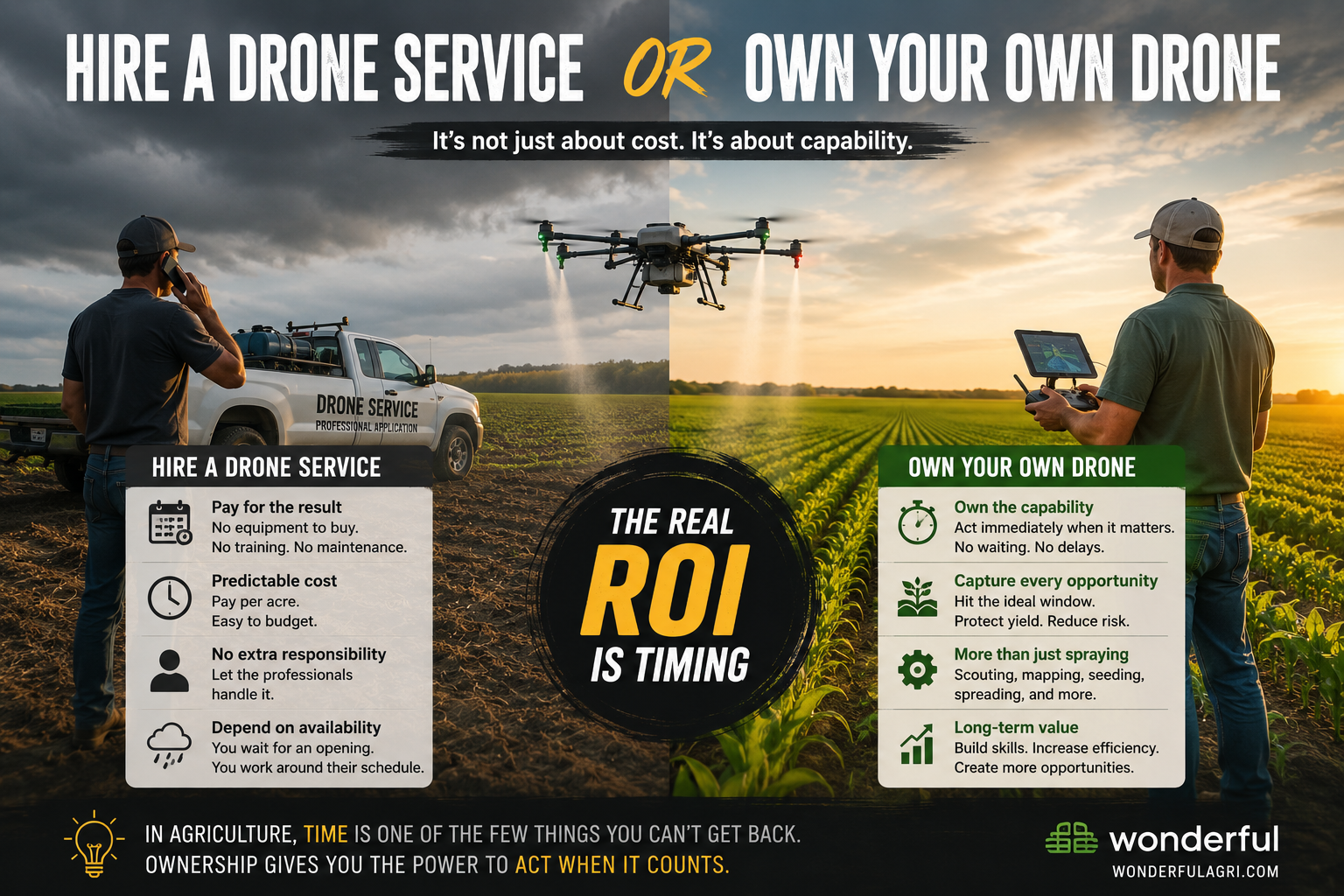
Before calculating ROI, it helps to understand that hiring a drone service and owning a drone are not really the same purchase.
When you hire a service provider, you are purchasing a result.
When you own a drone, you are purchasing a capability.
Neither approach is inherently right or wrong. The real question is which one fits your operation.
For smaller farms or operations that only require occasional applications, hiring a professional drone service may be the most practical solution. There is no equipment to purchase, no batteries to maintain, no software to learn, and no additional responsibilities to manage. When work needs to be done, a qualified operator arrives, completes the application, and moves on to the next job.
From a purely financial perspective, that can be an excellent business decision.
As farm size increases, however, or as the value of the crop and the importance of timing become more significant, the conversation often begins to change.
At that point, the question is no longer how much is being spent per acre.
The question becomes who can act first.
One of the realities of agriculture is that many things can be corrected.
Timing is rarely one of them.
A disease outbreak does not pause because an application has not yet been scheduled. Weeds do not stop growing because a contractor is booked for the next three days. A favorable weather window does not remain open simply because someone is waiting for equipment to become available.
In many situations, the difference between success and disappointment is measured not in weeks, but in hours.
Imagine a situation where a crop requires treatment immediately, yet the next available application slot is three days away. If the ideal treatment window is only a day long, the cost of waiting may easily exceed whatever savings were achieved by outsourcing the work.
That is why many farmers who eventually invest in their own agricultural drone discover something unexpected.
The greatest return on investment often has very little to do with the number of acres they spray.
Instead, it comes from having options.
They gain the ability to respond immediately when conditions change.
They can prioritize the fields that need attention most urgently.
They no longer have to work around someone else’s schedule.
And when an opportunity appears, they are able to act rather than wait.
The value of that flexibility is difficult to place on a spreadsheet, yet it is often where the real return on investment is created.
Of course, ownership does not automatically guarantee a positive outcome.
A drone sitting in a shop generates no return at all.
Purchasing equipment is only the beginning of the journey. Training, maintenance, operational knowledge, practice, and continuous learning all play a role in determining whether that investment ultimately succeeds.
This is why some operators look back on their drone purchase as one of the best decisions they ever made, while others feel it never delivered the value they expected.
More often than not, the difference is not the equipment.
It is whether the operator developed the ability to use the technology effectively.
In that sense, agricultural drones are not very different from tractors.
Nobody becomes a great farmer simply by purchasing a tractor.
Likewise, nobody achieves a strong return on investment simply by purchasing a drone.
The equipment matters, but the person behind the equipment matters even more.
So when someone asks whether hiring a drone service or buying a drone makes more sense, my answer is usually the same.
If your goal is simply to complete a few applications each season, hiring a professional service provider may be the easiest and most economical choice.
However, if your operation would benefit from greater flexibility, faster response times, and the ability to act whenever conditions require it—and if you are willing to invest the time needed to learn and develop that capability—then owning an agricultural drone may create value that extends far beyond the purchase price itself.
Because in the end, ROI is rarely determined by the machine alone.
It is determined by how many opportunities the machine allows you to capture.
Agriculture offers many second chances.
Timing is usually not one of them.
So before making a decision based solely on equipment costs, ask yourself one more question.
If tomorrow offers the perfect application window, and the decision must be made tonight, would you rather join a waiting list—or be ready to take off?
For every farm, the answer will be different.
And that answer may ultimately determine whether a drone becomes an expense or an investment.
Prepared by
Wonderfull Inc.
Transport Canada Recognized RPAS Flight School
Certified Advanced Flight Reviewer
Drone Compliance | DJI Academy | Sales | Parts | Service
Office: 647-800-7952
Text: 647-287-6851
5955 10 Sideroad
Innisfil, ON L0L 1K0
Canada