
A few years ago, I found myself thinking about a question that had never appeared on a sales brochure.
It wasn’t about tank size, spray width, battery life, or how many acres a drone could cover in an hour. It wasn’t about financing options, seasonal promotions, or how quickly parts could be shipped.
In fact, it wasn’t really about drones at all.
The question was surprisingly simple:
Years from now, after the equipment has been replaced, upgraded, repaired, and eventually retired, what will still belong to you?
At first, the answer seemed obvious. Most people would probably point to the drone itself. After all, when someone spends tens of thousands of dollars on equipment, it is natural to focus on the equipment. We compare specifications, calculate return on investment, evaluate performance, and negotiate pricing. We spend a great deal of time deciding what to buy.
What we rarely discuss is what remains after the purchase has long been forgotten.
The longer I have worked in agriculture, the more I have come to appreciate how quickly tools change. Tractors that once represented the latest technology eventually become trade-ins. Trucks accumulate miles. Software evolves. Equipment manufacturers release newer models with better features. The agricultural drone industry moves especially fast. A machine that feels cutting-edge today may look very different only a few years from now.
None of this is a problem. It is simply the nature of technology.
What surprised me, however, was realizing that the most valuable thing many successful operators gain from their equipment is not the equipment itself.
It is what they learn while using it.
Over the years, we have worked with farmers, custom applicators, and entrepreneurs from very different backgrounds. Some entered the industry with decades of agricultural experience. Others had never operated a drone before. Some built successful businesses quickly. Others took longer and learned through setbacks, mistakes, and difficult lessons.
Yet when I look back at the operators who ultimately achieved the greatest success, I rarely find that their advantage came from owning the newest machine.
More often, their advantage came from what they knew.
They learned how to plan operations more effectively. They learned how to identify risks before they became problems. They learned how to communicate with customers, manage expectations, maintain equipment, and make better decisions when conditions were less than ideal.
Those lessons did not arrive all at once.
They accumulated over time.
And unlike equipment, they did not lose value.
That is why I have gradually come to believe that many people misunderstand what they are actually purchasing when they buy an agricultural drone.
They think they are buying a machine.
In reality, they are buying an opportunity to develop a new capability.
The drone itself is only part of the investment. The larger investment is the learning that follows.
Give the same aircraft to two different people and the outcomes may be completely different. One operator may struggle through avoidable mistakes, while another steadily improves year after year. The difference is not always intelligence, and it is not always experience. More often, it comes down to whether the individual continues learning and whether they have access to the knowledge, support, and guidance needed to grow.
This is one reason we place so much emphasis on training and long-term support. Not because training replaces experience, but because it helps people benefit from experience without paying the full cost of every lesson themselves. Every industry advances by passing knowledge from one generation to the next. Agriculture is no different.
When I think about the most successful operators we know, I don’t remember which promotion they received when they purchased their drone. I don’t remember how many free accessories were included in the package or whether they saved a few hundred dollars on the original transaction.
What I remember is how much they grew.
I remember the confidence they developed after solving difficult problems. I remember the judgement they gained through learning. I remember watching them become more capable, more efficient, and more successful with every season that passed.
Those things stayed with them long after the equipment changed.
And perhaps that is the most important lesson of all.
Money is necessary. Equipment is necessary. Every successful operation needs both.
But money spent eventually leaves your hands, and equipment inevitably grows old.
Knowledge works differently.
The more you use it, the more valuable it becomes.
The more challenges you face, the more useful it becomes.
And years later, when today’s technology has become yesterday’s technology, the knowledge, judgement, and experience you gained along the way may turn out to be the most valuable return on investment you ever received.
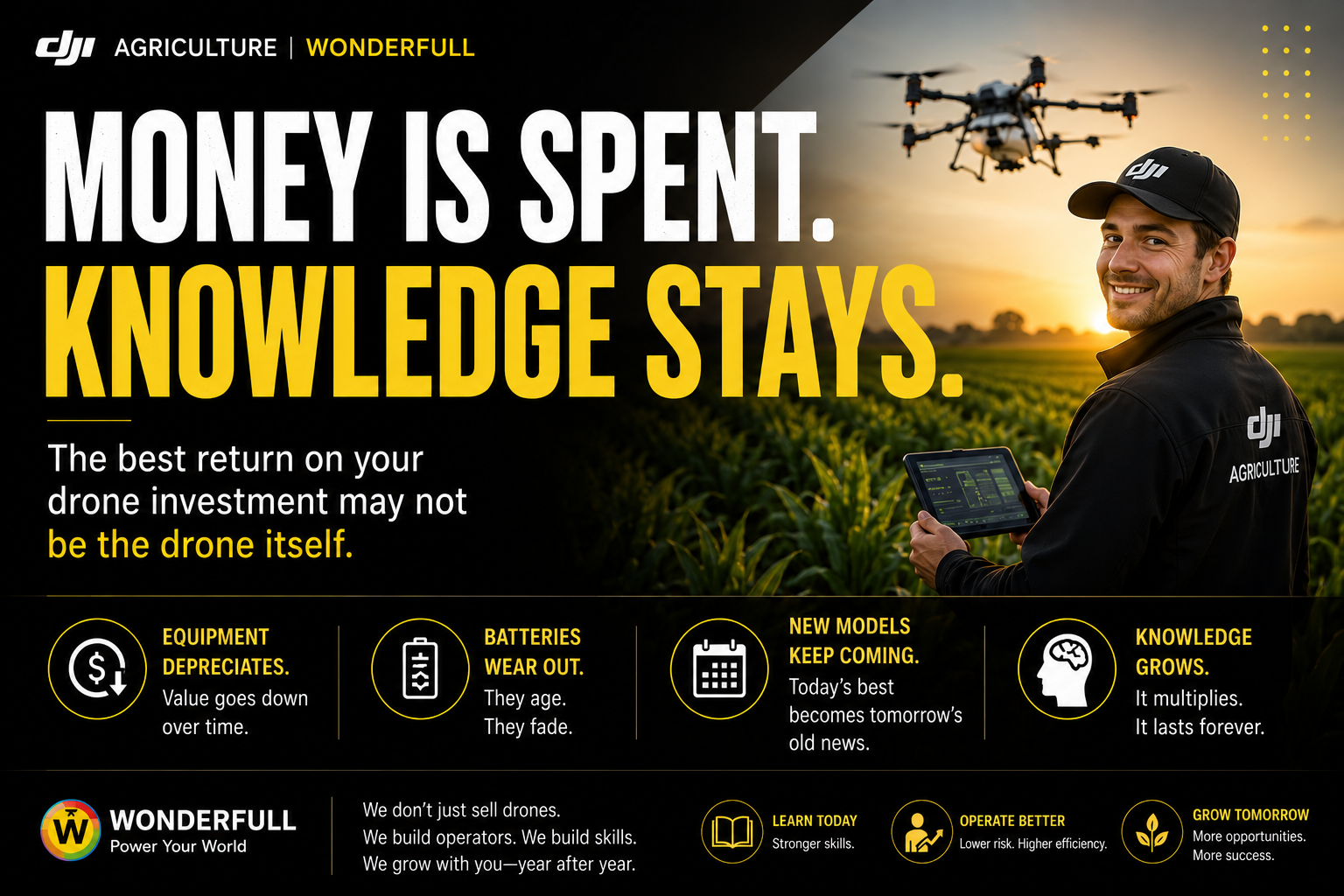
Because in the end, money is spent.
Knowledge stays.
Prepared by
Wonderfull Inc.
Transport Canada Recognized RPAS Flight School
Certified Advanced Flight Reviewer
Drone Compliance | DJI Academy | Sales | Parts | Service
Office: 647-800-7952
Text: 647-287-6851
5955 10 Sideroad
Innisfil, ON L0L 1K0
Canada