
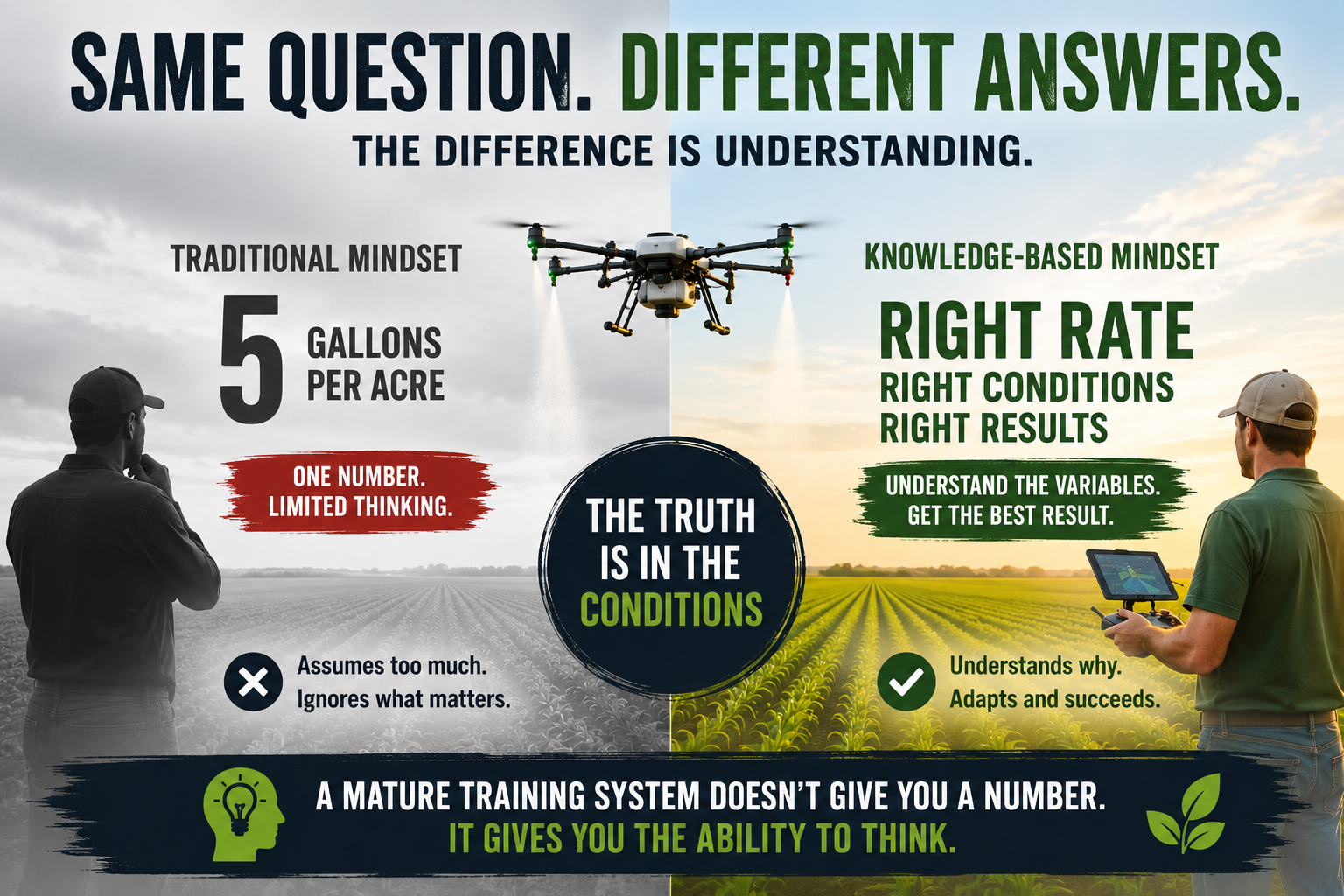
One of the most fascinating things we’ve observed in the agricultural drone industry over the past several years is how often the same question can produce completely different answers.
Ask a group of people about spray volume, and one person may tell you that 2 gallons per acre is sufficient, while another may insist that 5 gallons per acre is necessary to achieve acceptable results. Ask whether drones can become a primary application tool, and some operators will tell you they are already changing the way farms work, while others will argue that drones remain a niche technology with limited applications.
For someone new to agricultural drones, these conflicting opinions can be frustrating. Everyone seems confident in their conclusions, everyone appears to have data to support their position, and everyone has a story that reinforces what they believe to be true.
So who is right?
The longer we work in this industry, the more we have come to believe that this is often the wrong question. A far more useful question is whether everyone is looking at the problem through the same knowledge framework in the first place.
Consider a simple example. If someone asks whether one kilogram of iron weighs more than one kilogram of cotton, the answer is straightforward because weight has a clear physical definition. One kilogram is one kilogram, regardless of the material.
Agricultural drone application is not that kind of question.
When someone asks whether 2 gallons per acre or 5 gallons per acre is correct, they are not asking a question with a single universal answer. They are asking a question influenced by a large number of variables, many of which can significantly affect the outcome.
Crop type matters. Product chemistry matters. Nozzle selection, flight speed, flight altitude, temperature, humidity, wind conditions, and application objectives all play a role. Change any one of those factors and the results may change as well.
In other words, agricultural drone application is not a mathematics problem with a fixed answer. It is much closer to a physics problem, where understanding the relationships between variables is often more important than memorizing a number.
This is why two research groups can sometimes reach different conclusions without either group necessarily being wrong. The most important question is not simply what result was obtained, but how that result was obtained. Understanding the conditions of the test, the variables that were controlled, the variables that were not controlled, and the assumptions that influenced the process often reveals far more than the final number itself.
Scientific thinking has never been about choosing sides as quickly as possible. It has always been about understanding why differences exist in the first place.
Unfortunately, agricultural drones are still a relatively new technology in many parts of the world, and it is only natural for people to evaluate new tools using familiar ways of thinking. The challenge is that drones are not simply smaller tractors, nor are they smaller airplanes. They operate differently, generate different airflow patterns, influence droplet movement differently, and require different application strategies.
As a result, applying traditional assumptions to a completely new technology does not always produce accurate conclusions.
Every new tool requires a new understanding, and every new understanding requires a knowledge system capable of supporting it.
That is one of the reasons why, when agricultural drones first arrived in Canada nearly a decade ago, we focused so heavily on education, training, and operator development. Of course equipment matters, and technology matters, but technology alone does not create confidence, consistency, or sound decision-making. Without a strong knowledge system behind it, even the most advanced equipment can be misunderstood, underutilized, or applied incorrectly.
Over the last eight years, we have invested significant time building training programs, operational procedures, support systems, and learning resources because we believed that agricultural drones would eventually require far more than machines. They would require a community of operators capable of understanding how the technology works, why it works, and how to adapt it to real-world agricultural conditions.
Today, when we see operators who are more confident, more consistent, and more capable of making sound decisions under changing conditions, we are reminded that the true value of any technology rarely comes from the hardware alone. It comes from the knowledge that supports it.
Technology will continue to evolve, research will continue to expand, and new data will continue to emerge. That is simply how progress works. What should remain constant, however, is the ability to think critically, understand variables, and make informed decisions based on evidence rather than assumptions.
A mature training system does not tell people what to believe. Instead, it teaches them how to evaluate information, understand why different results may occur under different conditions, and develop the confidence to make informed decisions when conditions inevitably change.
Agriculture does not benefit from more arguments about who is right. What it benefits from is a greater understanding of how conclusions are reached, how evidence should be evaluated, and how knowledge can be applied in the field.
In the end, the most valuable thing a training system can provide is not a number on a spray chart.
It is the ability to understand where that number came from, when it applies, and when it does not.
Read More: https://www.wonderfull.ca/learning-center/
Wonderfull | DJI Agriculture | DJI Academy Canada
Training Pilots. Supporting Pilots. Building Success.
Prepared by
Wonderfull Inc.
Transport Canada Recognized RPAS Flight School
Certified Advanced Flight Reviewer
Drone Compliance | DJI Academy | Sales | Parts | Service
Office: 647-800-7952
Text: 647-287-6851
5955 10 Sideroad
Innisfil, ON L0L 1K0
Canada