
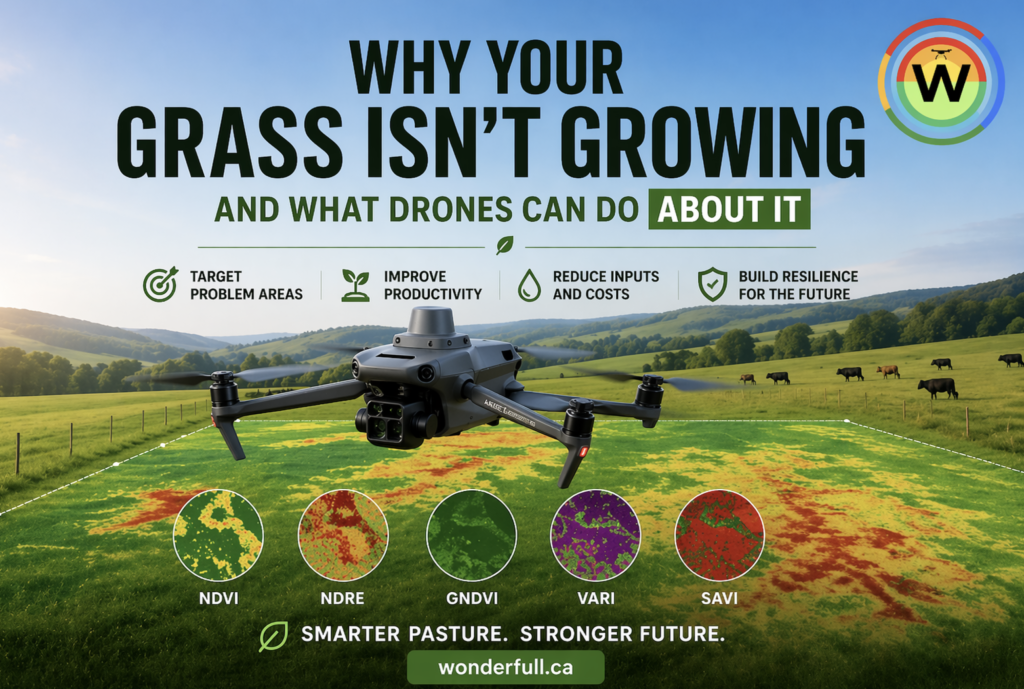
Do You Really Need to Change Your Pasture Management
Or Have You Just Gotten Used to the Losses?
Let’s start with a simple question:
Is your pasture actually improving, or slowly declining?
Most operations follow the same routine:
- Overseed a little each year
- Spray when needed
- Hope for good weather
But the reality is often different:
- Grass species are declining
- Bare ground is increasing
- Weed pressure keeps growing
- Drought years hit harder than before
Is this just “how it is”, or is it something that can be fixed?
Does This Sound Familiar?
Think about your own fields:
- High-traffic areas getting thinner every year
- Slopes or wet spots that are difficult to manage
- Some areas thriving, others always struggling
- The more you manage, the less uniform it feels
Now ask yourself:
Are you actually improving your pasture, or just maintaining what’s left?
What If You Could Actually Bring Your Pasture Back?
Let’s focus on outcomes.
What if you could:
- Bring grass back to bare areas
- Restore a healthy species mix such as alfalfa, ryegrass, and clover
- Reduce weed pressure
- Increase overall productivity
What would that mean for your operation?
Your cattle stop waiting for grass. The grass is ready for them.
So How Do You Actually Get There?
Traditional methods have limitations:
- ATV seeding is uneven and causes compaction
- Manual seeding is slow and costly
- Tractors cannot access wet or sloped areas
So many producers conclude:
It is what it is.
But today, there is a different approach:
Precision overseeding.
Precision Overseeding Is Not Just Seeding Again
It Is Rebuilding Your Pasture
Instead of spreading seed blindly across the whole field:
- Weak areas are targeted
- Bare spots are reinforced
- Mixed species are applied precisely
At the same time:
- No soil compaction
- No terrain limitations
- Wet areas are no longer a barrier
This is not just an improvement. It is a different system.
What Kind of Results Are We Talking About?
Real outcomes, not theory:
Pasture productivity can increase by 20 to 35 percent after overseeding.
This means:
- More forage from the same land
- Greater stability for your herd
- Better return per acre
What About Drought Years?
Many operations feel they have no control.
When drought hits:
- Growth slows or stops
- Root systems are shallow
- Production drops sharply
But is there really nothing you can do?
Acting Before It Is Too Late
At the right time, you can apply:
- Potassium to improve drought tolerance
- Magnesium and sulfur to support protein and photosynthesis
- Biostimulants to enhance root development
With drone application:
- Finer droplets improve absorption
- 30 to 50 percent less input is required
- Coverage is more uniform
The result is not eliminating drought impact, but reducing it significantly and maintaining production.
Are You Watching Your Pasture or Managing It?
Most producers observe problems after they appear.
But what if you could:
- Detect weak zones early
- Track regrowth in real time
- Predict fall forage availability
Aerial Monitoring Turns Observation into Decisions
With NDVI mapping, you can clearly identify:
- Healthy areas
- Declining zones
- Areas requiring action
This is not just observation. It is informed decision-making.
Why Does Rotational Grazing Sometimes Fall Short?
It is not just about dividing land.
The real issue is:
- Uneven growth
- Inconsistent recovery
Which leads to cattle waiting for grass.
What If Recovery Was More Uniform?
With targeted overseeding, precision nutrient application, and real-time monitoring:
- Recovery becomes more consistent across paddocks
This allows rotational grazing to function as intended.
Are You Taking Weather Risk or Managing It?
Traditional systems depend heavily on weather:
- Good years bring modest gains
- Bad years bring significant losses
Precision pasture management changes this:
- Strong years build biomass
- Weak years maintain baseline production
- Bare ground decreases, reducing weed pressure
This shifts your operation from reacting to stabilizing.
What About Your Soil?
Pasture challenges are often soil challenges.
If you can:
- Increase ground cover
- Promote deeper roots
- Improve water retention
Your soil becomes more resilient, functioning like a sponge.
This leads to:
- Better drought resistance
- More consistent yields
- Stronger long-term performance
Let’s Talk About Cost
You may be wondering whether this increases costs.
In reality:
- Inputs such as chemicals, water, and labor can be reduced
- Government programs such as OFCAF and CAP may provide support
- Precision agriculture practices may qualify for funding
The goal is not to spend more, but to spend more effectively.
Do You Need to Own a Drone?
Not necessarily.
There are two approaches:
Owning a system
Best suited for larger operations or frequent use
Using a service provider
Best suited for smaller farms or those who want to start without investment
The real question is not how you implement it, but whether you begin.
The Most Important Point
Pasture is not just feed. It is the foundation of your profitability.
Better pasture leads to:
- Healthier cattle
- Lower feed costs
- More predictable returns
Start With a Simple Step
There is no need to decide immediately.
Consider your own operation:
- Where can it improve
- What is the potential gain
- What would it cost
We can help you:
- Conduct a simple assessment
- Arrange a live demonstration
See the Results for Yourself
You do not need to believe in the technology.
You only need to see what it can do.
From there, the decision becomes clear.
Prepared by
Wonderfull Inc.
Transport Canada Recognized RPAS Flight School
Certified Advanced Flight Reviewer
Drone Compliance | DJI Academy | Sales | Parts | Service
Office: 647-800-7952
Text: 647-287-6851
5955 10 Sideroad
Innisfil, ON L0L 1K0
Canada
Supported by
Canadian Agricultural Drone Council (CADC)
cadadc.ca