
Completing the drone application does not necessarily mean the cover crop was successfully established.
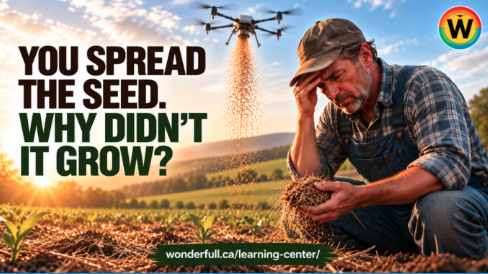
This year, we have been hearing a different kind of question from farmers.
In many of these cases, there is nothing obviously wrong with the drone. The aircraft flies normally, the spreader works, the mission is completed, and the application record looks exactly as it should. From the equipment’s point of view, everything went according to plan.
The problem appears later, when the farmer goes back to the field and asks a much more important question: Where is the cover crop?
The seed was purchased. The field was flown. The time and labour were invested, and in many cases the planting window has already passed. Yet emergence may be poor, establishment may be uneven, or very little of the expected cover crop may appear at all.
A broken machine can usually be diagnosed and repaired. A missed establishment window is much harder to get back.
That is why we think the conversation around drone seeding needs to move beyond one question — Did the drone successfully spread the seed? — and toward another:
What happened to the seed after it left the drone?
Spreading Seed and Establishing a Cover Crop Are Not the Same Thing
We believe agricultural drones can be an excellent tool for cover crop applications, particularly when the standing crop prevents conventional equipment from entering the field or when an earlier seeding window can provide an agronomic advantage.
That flexibility is one of the reasons aerial seeding is so attractive.
However, as more acres are being seeded by drone, an important distinction is becoming clearer: a successful application is not necessarily a successful establishment.
The drone can control where it flies, how the spreading system operates, and how much material it intends to apply. Once the seed leaves the spreader, however, the rest of the story is influenced by the crop, the seed itself, the soil surface, field conditions and the weather that follows.
That part of the process is considerably more complicated than simply getting an aircraft to complete a mission.
Is It Really Just About Rain?
When a cover crop fails to establish after aerial seeding, one explanation comes up frequently:
“Maybe it didn’t get enough rain.”
Rainfall absolutely matters. A seed sitting near the soil surface has very different access to moisture than one placed into the soil with good seed-to-soil contact, and a prolonged dry period after broadcasting can certainly reduce germination and establishment.
But rainfall is one variable in a much larger system.
At a recent TIMAC AGRO event, we had a good conversation with friends from Quality Seeds about cover crop establishment and the proper use of drones for these applications. Conversations like this are important because the more closely we look at establishment, the more obvious it becomes that there is rarely one universal explanation for success or failure.
Crop stage and canopy structure matter. Row spacing can matter. Seed characteristics, soil-surface conditions, application timing and the weather before and after seeding can all influence what eventually happens in the field.
Even rain itself is not simply a matter of whether it rained or not. Timing and field conditions can produce very different outcomes.
So yes, rain matters.
But “maybe it didn’t rain” should not always be the end of the diagnosis.
Sometimes it should be the beginning.
Before We Ask Whether the Seed Germinated, We Should Ask Where It Landed
Corn provides a simple example.
Standing at the edge of a field, it is easy to look between the rows and assume that seed released from above will simply fall through the crop and reach the ground. But as corn develops, the canopy changes, and the path between the drone and the soil is not always as open as it appears from the edge of the field.
This creates an important distinction:
The drone recording that the correct amount of seed was distributed does not necessarily mean every seed arrived where we expected it to.
And canopy is only one example.
Different seeds behave differently. Different crops create different environments, and field conditions change what happens between the moment a seed leaves the spreading system and the moment it has an opportunity to establish.
A setting that worked very well somewhere else is therefore not automatically a recipe for success in the next field.
There is much more behind that statement, but this is where we will deliberately stop rather than turn an article into an application manual.
The important point is simple:
The drone knows that it completed the mission. It does not know whether the cover crop grew.
That judgement still belongs to us.
The Same Drone, the Same Seed — So Why Did One Field Work and Another Fail?
Two growers may use the same DJI Agriculture drone and the same spreading system. They may even seed the same cover crop species at roughly the same time. One field establishes beautifully, while another produces a disappointing result.
It is tempting to find the most visible difference and call it the answer. Sometimes that answer will even be correct.
But agriculture rarely gives us the luxury of working with only one variable.
Good troubleshooting requires us to look at the application as a system rather than jumping immediately to the easiest explanation. There are technical factors behind that process that we are intentionally not going to unpack here.
The point is not that every failed cover crop requires an impossibly complicated investigation.
The point is that poor establishment deserves a better diagnosis than the first convenient explanation.
Experience Is Valuable. It Is Also Expensive.
Agriculture has always depended on experience, and some of the most valuable agricultural knowledge comes from farmers who have spent decades learning how their own land responds under different conditions.
We have enormous respect for that kind of experience.
The difficulty is that experience is rarely free. Sometimes we pay for it with time, sometimes with money, sometimes with seed or a missed application window, and in agriculture, some lessons can cost an entire growing season before we know whether a decision was right or wrong.
By the following year, we have gained experience, but the cost of gaining it has already been paid.
That is one of the reasons knowledge matters. It allows us to learn not only from what happened to us personally, but also from research, testing, measurement, previous failures and the experience accumulated by other people. We do not need to personally make every possible mistake before we can understand it.
That is why we study. It is why we go to school, why research matters, and why good technical training should do more than teach someone which buttons to press.
Experience tells you what happened. Knowledge explains why.
Once we understand why, we have a much better chance of recognizing the same risk before paying for the lesson again.
The Real Technology Is No Longer Just Making the Drone Fly
Agricultural drones have advanced enormously. Aircraft are more capable, payloads are larger, automation is better, and the number of acres that can be covered in a day would have been difficult to imagine only a few years ago.
As the machines become more capable, however, the question of how we use that capability becomes increasingly important.
For years, much of the agricultural drone conversation has naturally focused on productivity: acres per hour, payload, flight time, application speed and how quickly a job can be completed. Those measurements matter because efficiency has real economic value on a farm.
But if a cover crop ultimately fails to establish, the number of minutes it took to fly the field suddenly becomes much less impressive.
That is why we believe the industry needs to measure success in more than acres flown.
How many acres did you fly? is an equipment question.
How many acres actually worked? is an agricultural question.
The second one is where the next stage of agricultural drone technology becomes interesting.
Eight Years, One Technology
Wonderfull has been focused on DJI Agriculture for eight years.
During that time, we have not jumped from brand to brand or treated agricultural drones as the next hot product. We chose DJI Agriculture and kept going deeper — through different generations of aircraft, spraying and spreading systems, crops, applications, field conditions, and more than a few problems that never made it into the manual.
The market has changed considerably during those eight years. New equipment has arrived, agricultural applications have expanded, and funding programs have helped more farmers gain access to technology that might otherwise have required a much larger initial investment.
We think that is a good thing. A good funding program can lower the financial barrier to adopting useful technology.
What it should not do is lower the standard by which we decide whether that technology is appropriate for a customer.
Funding can reduce the cost of adoption. It cannot guarantee the outcome.
The value of an agricultural drone should therefore not be measured simply by how little someone paid for it on the day it was purchased. Real value for money appears afterward: in whether the equipment is appropriate for the operation, whether the operator understands how to use it properly, whether there is knowledgeable support when something goes wrong, and whether the technology continues producing useful results after the excitement of buying a new machine has worn off.
That is why product quality and training quality have always mattered to us. Selling the machine is part of the job, but it is not our definition of a successful outcome.
We want customers to understand not only what their equipment can do, but also where its limitations are, what changes when the application changes, and when a result in the field is telling us that we need to look deeper.
And, after eight years, apparently we have looked pretty deep.
In Chinese, we have some rather colourful ways of describing someone who spends eight years obsessing over one thing.
Here in Canada, we’ve learned to call it “specialization.”
We like the Canadian version better.
Joking aside, those eight years matter to us not simply because they gave us experience, but because experience, when it is questioned, tested and studied, should eventually become knowledge.
If eight years meant doing the same thing the same way over and over again, the number itself would not mean very much. What matters is the systematic knowledge that develops when years of field work are combined with learning, testing, technical understanding, failures, successful applications and the discipline to keep asking why.
We certainly have not seen every agricultural drone problem there is, and anyone who works in agriculture long enough knows better than to make that claim.
But after eight years, unusual problems do not scare us very much anymore.
If Your Cover Crop Didn’t Establish, Talk to Us
If you used a drone to seed cover crops this year and experienced poor emergence, uneven establishment or results that simply did not match what you expected, we would be interested in hearing what happened.
Do not immediately assume that the drone failed.
And do not end the investigation with “maybe it didn’t rain.”
Rain matters, but rain is never the whole system.
Tell us about the field, the crop, the seed, the timing and what you observed. We will not promise that every problem has a simple answer, because responsible technical work should not pretend that it does.
What we can promise is that we will be interested in finding the reason.
After eight years focused on DJI Agriculture, that is still the part we enjoy most.
Some answers aren’t in the manual. They’re in the field.
And when the answer is somewhere in the field, systematic knowledge helps you know where to look.
WONDERFULL INC.
Transport Canada Recognized RPAS Flight School
Certified Advanced Flight Reviewer
Drone Compliance | Academy Training (DJI Standard) | Sales & Service
Office: 647-800-7952
Text: 647-287-6851
5955 10 Sideroad
Innisfil, ON L0L 1K0
Canada