
Over the past few years, we’ve talked with a lot of people who are interested in agricultural drones, and everyone seems to be coming into the conversation from a slightly different place.
Some have been flying for years. They know the equipment, they’ve covered a lot of acres, and they’ve learned what actually works once you get into the field. Others have already owned a drone or two, made a few mistakes along the way, and probably have a list of things they would do differently next time.
Then there are farmers who are just getting started. They’re seeing drones spray, spread, map, or collect crop data for the first time, and they’re excited about what might be possible.
That’s all part of where this industry is today.
The technology is moving quickly, with new aircraft, new capabilities, and new applications coming all the time. We’ve been working in this industry for years, and we’re still learning too.
So this isn’t an article about which brand is “the best,” and we’re not going to tell you which drone you should buy. There is a lot of excellent agricultural technology out there, from many different companies and many different parts of the world.
What matters is finding out whether a particular technology actually makes sense for you and your farm.
1. Before Asking Which Drone Is Best, Ask What You Actually Need It to Do
It sounds basic, but this may be the most important question of all.
A farmer who wants a drone for their own acres has very different needs from an operator planning to cover thousands—or tens of thousands—of acres commercially. One operation may be focused mainly on spraying, another may need spreading, while someone else may be more interested in mapping, multispectral imaging, or variable-rate application.
When a new drone comes out, it’s natural to ask how many acres it can cover in an hour, how much it can carry, or how fast it can fly. Those numbers matter, but before getting too far into the specifications, we think there’s a better question to ask:
“What can this actually do for my farm and the way I already operate?”
Once you have a good answer to that, questions about model, payload, productivity, and budget usually become a lot easier.
2. Can the Drone “Talk” to the Technology You Already Have?
This is something we’re hearing more and more as drones become part of the larger precision-ag picture.
A farmer might ask us:
“I already have an RTK base station on my farm. Can the drone use it?”
Another might be working with multispectral imagery and wondering how to turn that data into an actual variable-rate application.
Then there are questions about moving data between equipment:
“Can I use the field maps from my tractor with the drone? Can the maps or data from the drone go back into my tractor or other equipment?”
These questions may not sound as exciting as payload capacity or flight speed, but over the long term, they may matter a lot more.
Agricultural drones increasingly shouldn’t operate as an island. If your farm already uses GPS, RTK, yield maps, prescription maps, multispectral imagery, or other precision-ag tools, it’s worth understanding how a new drone will fit into that existing workflow before you buy it.
Can it actually work with the system you’ve already built?
Good technology shouldn’t simply add another piece of equipment to the farm. It should help you get more value from the equipment, data, and experience you already have.
3. Don’t Just Look at the Drone. Look at the Whole Operation.
The aircraft gets most of the attention, especially when you’re buying your first agricultural drone, but it’s only one part of the system.
How will you charge the batteries? What kind of generator do you need? Are the batteries or charging systems interchangeable, or are there specific requirements?
If you’re working all day, how many batteries do you actually need? How will you manage water, product, transportation, mixing, and refilling?
And then there are the questions you may not think about until something goes wrong. If you need a part during the season, how quickly can you get it? Who do you call when you have a software, firmware, or technical issue? What kind of training and support is available after the sale?
Anyone who has done large-acreage drone application knows that the maximum speed of the aircraft isn’t always what determines how much work gets done in a day. Quite often, efficiency comes down to whether the whole operation can keep moving without unnecessary stops.
Can the entire system keep working smoothly and reliably, hour after hour?
That’s why it helps to zoom out a little when you’re comparing drones. You’re not just buying an aircraft; you’re bringing an entire working system onto the farm.
4. What If You Don’t Need to Buy One at All?
That’s worth thinking about too.
For some farms, hiring an experienced drone operator may make much more sense than owning the equipment. You avoid the investment, training, maintenance, charging infrastructure, and responsibility of operating the aircraft yourself.
But then the questions change.
How much real field experience does the operator have? What equipment are they using? Do they have appropriate insurance and safety procedures? Do they understand your crop and your fields? What happens when something goes wrong?
We’ve even had farmers ask us very directly:
“What happens if they crash a drone in my field and damage my crop?”
That isn’t a silly question. It’s a practical one.
Once drones move from being exciting new technology to becoming working agricultural equipment, these are the things that matter.
So for some farmers, the question may not be “Which drone should I buy?” at all.
It may be “Do I need to own one?”
5. Before You Buy, Look Around, Ask Questions, and Talk to People
Over the years, we’ve shared a lot of information about agricultural drones through the Wonderfull Learning Center—equipment, applications, training, and many of the practical questions we encounter in the field.
We don’t share those things because we believe the brands we sell are the only good technologies in the market. Agriculture is much bigger than any one company or manufacturer.
There is excellent technology being developed around the world, and experienced operators often come up with very different equipment setups and ways of working based on what they’ve learned over thousands of acres.
So before making a decision, it’s worth seeing different machines, learning how different systems work, and talking to people who have actually used them. Ask specific questions, including the ones that may seem too small or too practical to appear in a brochure.
When you’re preparing to make a significant investment, a few more questions are rarely a bad thing.
If you’re still doing your homework, you can start with the Wonderfull Learning Center:
👉 Wonderfull Learning Center
https://wonderfull.ca/learning-center/
At This Point, Talking About the Drone Alone Isn’t Enough
The longer we work in agricultural drones, the more strongly we feel this.
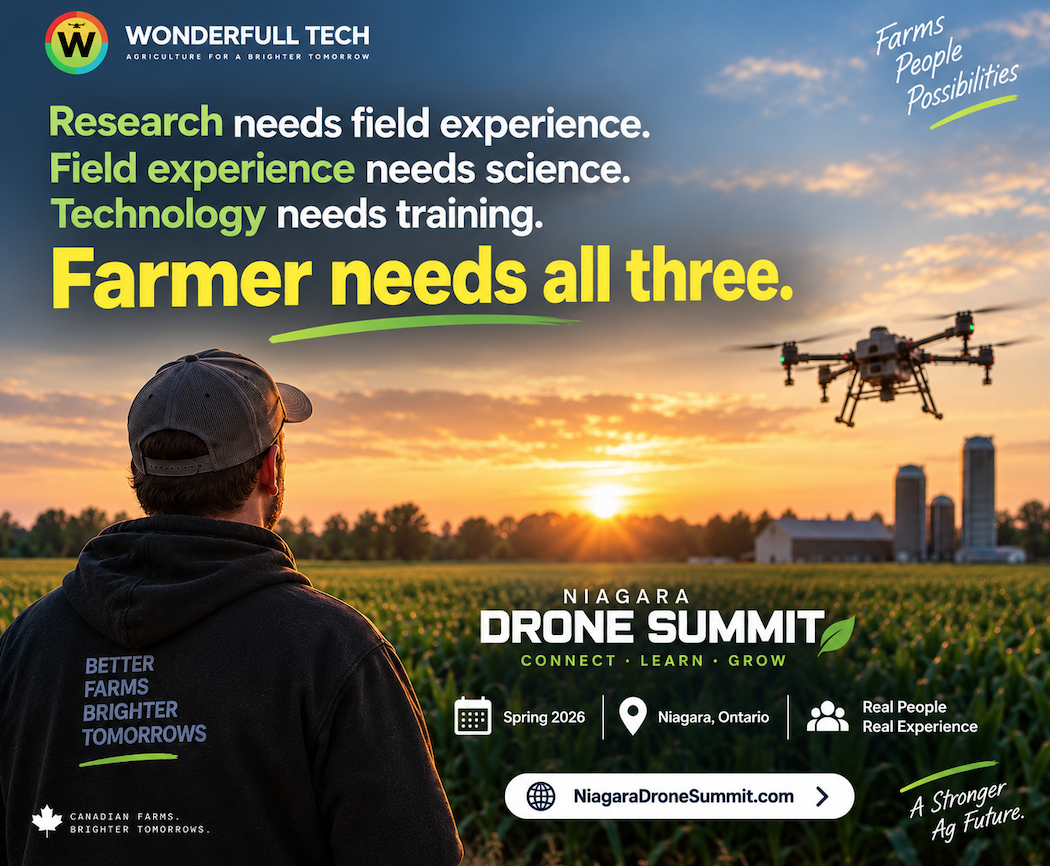
Research needs field experience.
Field experience needs science.
Technology needs training.
Farming needs them all to work together.
Research ultimately has to prove itself in the field, while the questions and problems we discover through real-world operation often need science and data to help us understand what is actually happening. Even the best technology can fall short if the people using it don’t have the right training.
The farm is where all of those things have to come together.
That’s a big part of why we’re hosting the Niagara Drone Summit.
We don’t want the Summit to simply be a place where people come to look at drones. We want to bring research, technology, training, and people with real field experience into the same place, because the conversations become much more useful when those perspectives are sitting around the same table.
One farmer may want to know whether an existing RTK system can work with a drone. Someone else may want to go deeper into multispectral imaging and variable-rate application. An operator may want to compare generators, batteries, charging systems, and field logistics. Someone may be thinking about becoming a professional operator, while another farmer may simply be trying to decide whether a drone makes sense for their operation at all.
We want those questions in the room, and we don’t expect everyone to give the same answer.
In fact, that’s part of the point.
If You’re Still Not Sure, Maybe Don’t Buy Yet
If you’re considering an agricultural drone but still have unanswered questions, we have one simple suggestion:
If you can, don’t rush to place an order before the Niagara Drone Summit.
Not because the Summit is going to give you one “correct” answer. We’d actually rather have you hear different answers from people with different kinds of experience.
We’re bringing together agricultural drone operators, industry professionals, technical experts, researchers, and people from different parts of the industry across North America. Some of the operators joining us have covered significant acreage over the past several years, so they know what it feels like to keep equipment running through long days and short application windows.
They also know that something can look great in a brochure and feel very different once you get it into a field.
Sometimes the things that seem small at first—charging time, logistics, parts, mapping compatibility, support, or simply how quickly you can solve a problem—end up making a very big difference at the end of the day.
If you’re thinking about buying a drone, come with your questions. Ask operators what they genuinely like about their setup, what mistakes they’ve made, what they thought would matter when they started but later realized wasn’t so important, and what they would do differently if they were starting again today.
You don’t need to come to the Summit ready to buy anything, and you certainly don’t need to leave agreeing with everyone you meet.
Come see what’s out there, ask the questions that matter to you, and talk to people who have actually done the work. Then take what you learn back to your own operation and decide what makes sense for you.
That’s really what we want the Niagara Drone Summit to be about:
Not making the decision for you, but helping you ask better questions before you make it.
👉 Niagara Drone Summit
https://NiagaraDroneSummit.com
Research. Science. Technology. Training. Field experience.
In the end, they all have to come together in one place:
the farm.
WONDERFULL INC.
Niagara Drone Summit 2026
Niagara Falls, Ontario
NiagaraDroneSummit.com