
Based on agronomic research, field trials, and Ontario grower experiences, including Pioneer Agronomy and Illinois Technology Development.
Same field. Different outcome. Timing matters.
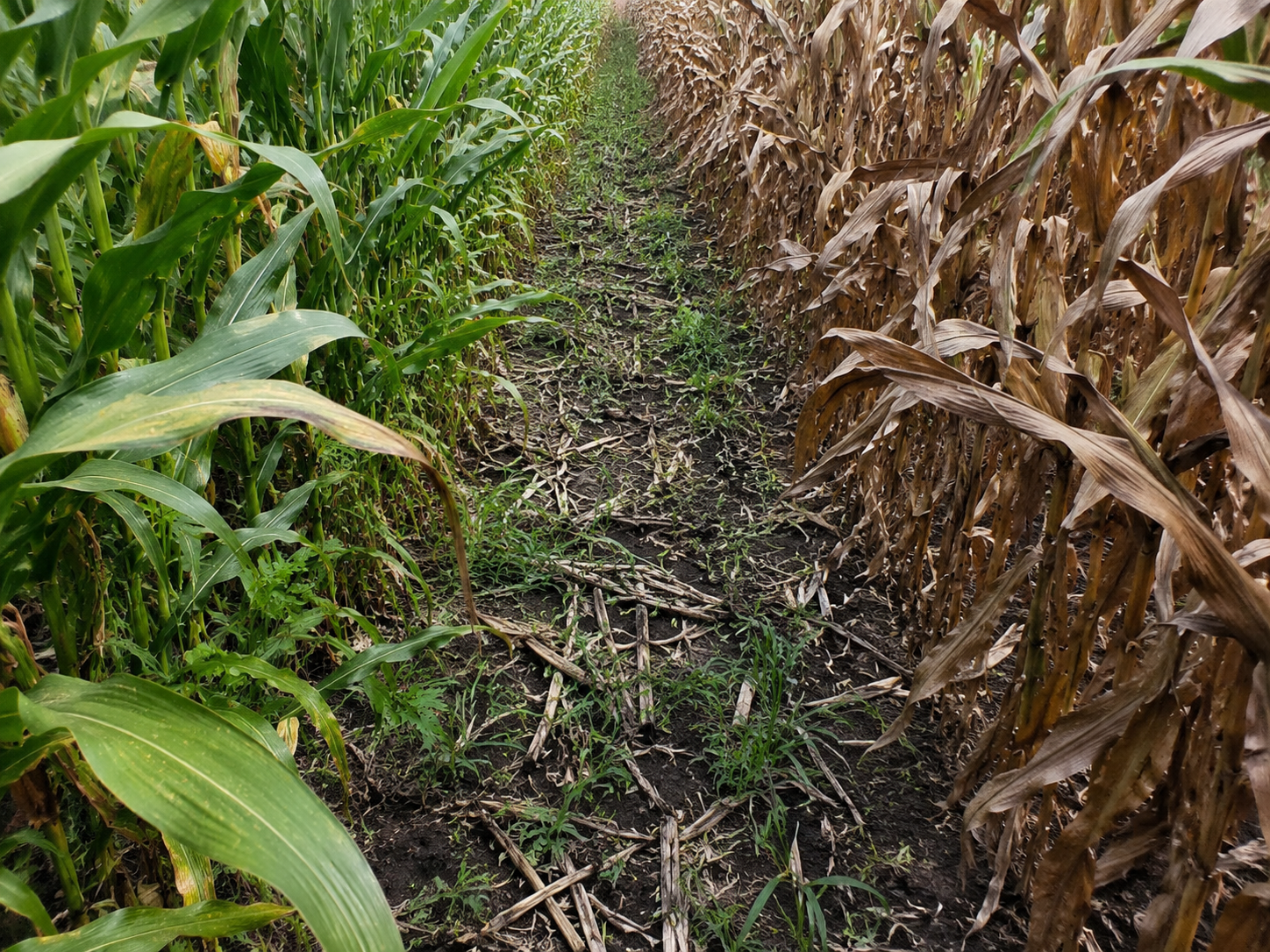
One side of the field was still green. The other showed obvious premature senescence and browning.
The caption was simple: “This is why fungicide applications matter.”
For corn growers, the difficult part about Tar Spot isn’t always finding the first few black spots. It’s not knowing what today’s relatively minor disease pressure could look like a week from now.
And once you decide a field needs a fungicide application, there is another very practical question:
Can you get it applied at the right time?
The Challenge Isn’t Always Deciding Whether to Spray. It’s Getting It Done on Time.
Fungicide timing matters in corn.
Research has consistently shown that the reproductive stages around tasseling and silking are an important fungicide application window in corn, with VT/R1 often providing consistent yield protection when disease risk is elevated.
But every farmer knows the field doesn’t follow your calendar.
You may decide that this is the week to spray, only to get two inches of rain.
The ground sprayer can’t get into the field.
By the time soil conditions improve, your custom applicator may already have a full schedule.
An airplane can be another good option, but availability, scheduling, field size and location can all come into play.
That leaves a very simple question:
“If I need to spray this week, can I actually get it done?”
Disease doesn’t wait for equipment to become available, and an application window doesn’t automatically move because the field is too wet.
What Is an Application Window Worth?
We don’t need to use a worst-case Tar Spot scenario to make the point.
Let’s use a simple example.
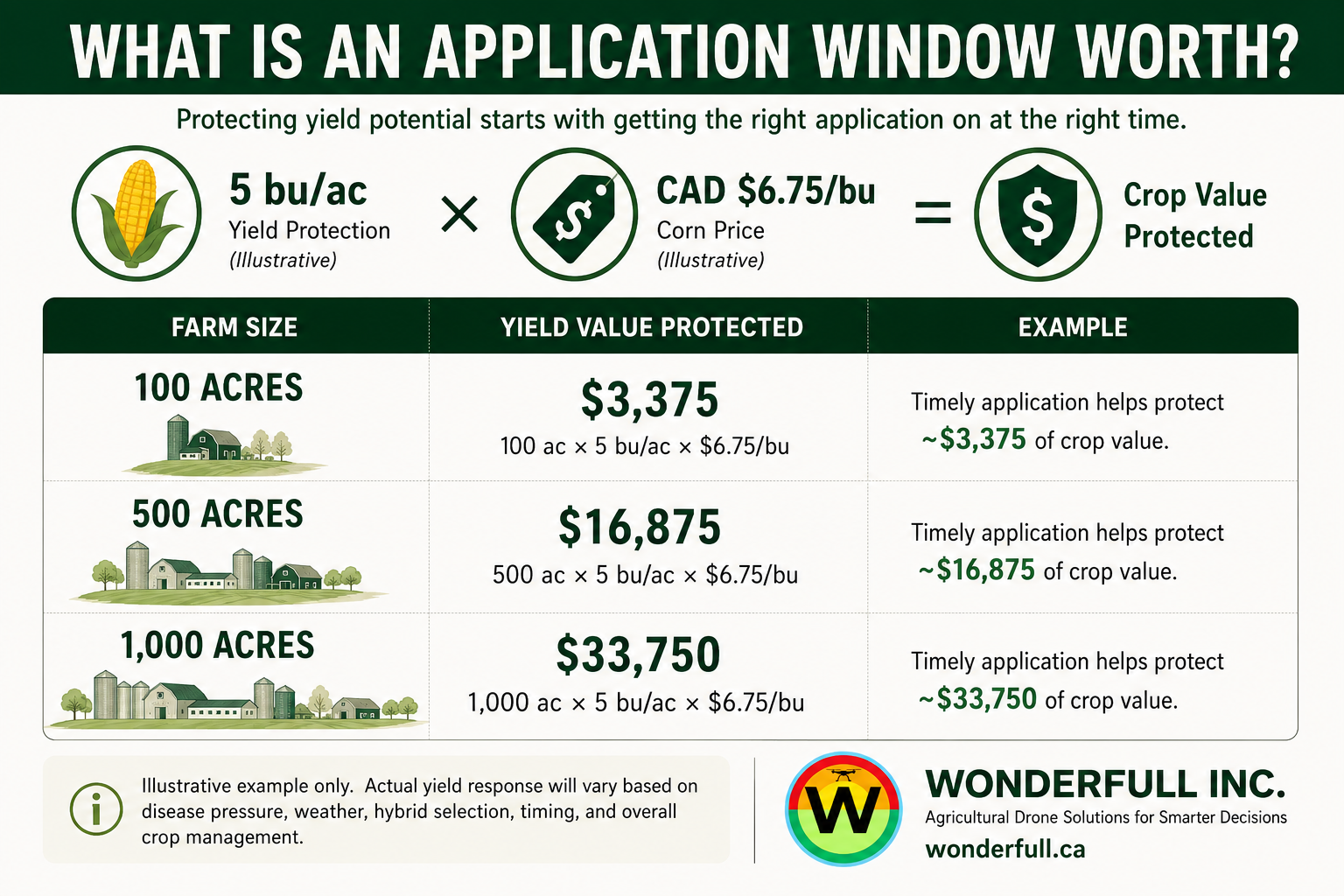
Suppose an Ontario grower has 100 acres of corn, and for illustration we value corn at CAD $6.75/bu.
Actual Ontario cash prices vary by location, basis, delivery month and market conditions. We’re simply using $6.75 to turn bushels into an easy-to-understand dollar value.
Now suppose disease pressure is present and a timely fungicide application ultimately protects 5 bu/ac of yield potential.
At $6.75 corn, that’s:
100 Acres → $3,375 of Crop Value
The same 5 bu/ac across 500 acres:
500 Acres → $16,875
And across 1,000 acres:
1,000 Acres → $33,750
The important part isn’t the $33,750 number itself. It’s understanding what that number represents.
We are not saying a fungicide application will add 5 bu/ac every year. And we are certainly not saying that using a spray drone automatically adds 5 bu/ac.
Some years, disease pressure is low and the fungicide response may be small. Hybrid susceptibility, weather, disease timing and overall crop management all influence the outcome.
The better question is this:
If you’ve already made the agronomic decision that a field needs to be treated, what is the value of getting that application done on time?
That’s often a more useful question than simply asking what it costs to spray an acre with a drone.
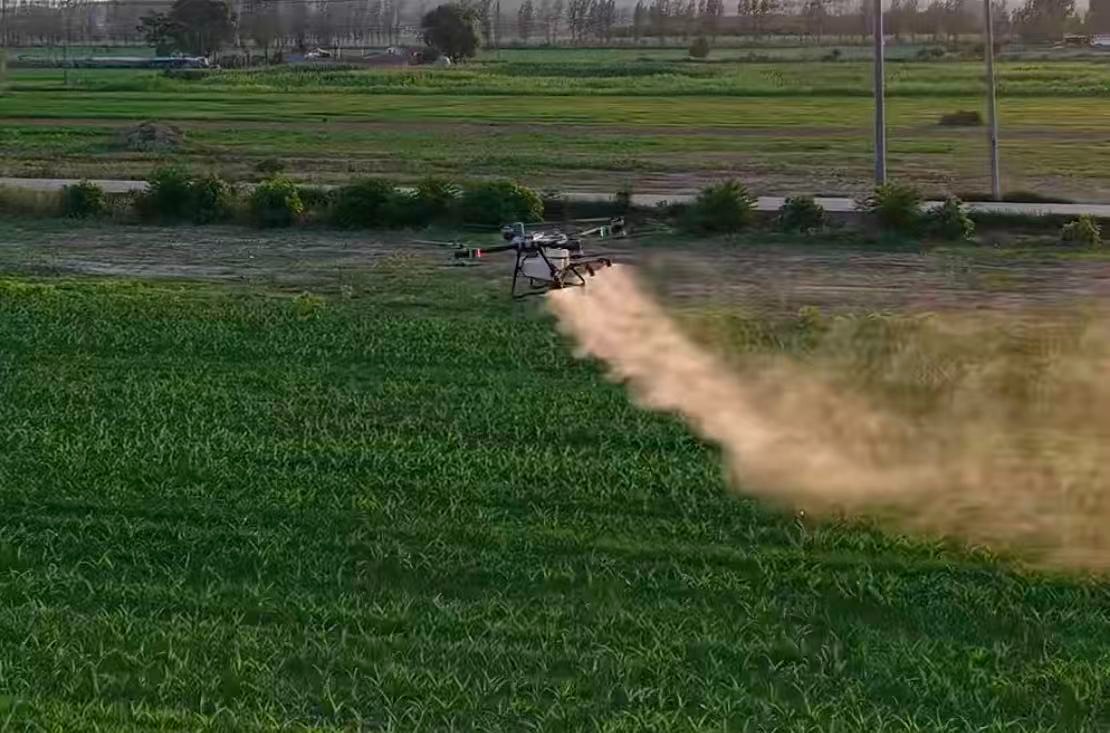
What a Spray Drone Really Adds Is Application Capacity
A spray drone isn’t valuable simply because it’s another way to apply a product.
Its value becomes more interesting when it gives the farm another way to get an application done when conditions aren’t cooperating.
Imagine you’ve just had significant rainfall. The soil isn’t ready for ground equipment, but disease pressure is increasing.
If you have your own aerial application capacity, the order of the questions begins to change.
Instead of starting with:
“Who can spray this for me this week?”
You can start with:
“When is the right time to spray this field?”
For some operations, that distinction matters.
A spray drone doesn’t create wheel tracks through standing corn or add soil compaction from a ground application vehicle. It can also provide flexibility for wet fields, smaller or irregular fields, and situations where a grower wants to prioritize a few fields rather than wait for an entire operation to be ready.
Ultimately, what you’re buying isn’t simply another spraying method.
You’re buying more:
Control Over Timing.
But Can a Low-Volume Drone Application Really Work?
That’s a fair question.
Having more flexibility doesn’t mean much if the application itself can’t deliver an effective result.
That’s why a 2021 field trial discussed by Illinois Technology Development is interesting.
In the trial, Preston and Jason compared fungicide applications made with a conventional ground rig and UAVs using much lower carrier volumes.
The corn results were:
| Application Method | Carrier Volume | Corn Yield |
| UAV | 2 GPA | 232.5 bu/ac |
| UAV | 3.5 GPA | 226.8 bu/ac |
| Ground Rig | 15 GPA | 229.0 bu/ac |
| No Fungicide | 0 | 207.8 bu/ac |
The interesting part isn’t that the 2 GPA UAV treatment happened to produce the highest yield in this trial.
One trial isn’t enough to say that a drone will outperform a ground rig.
What’s more useful is that the 2 GPA UAV treatment produced a corn yield comparable to the 15 GPA ground application, while both were above the untreated check.
That’s an important distinction.
Growers are used to applying fungicide with much higher carrier volumes from a ground rig, so it’s reasonable to question whether an application at 2 GPA can provide useful results.
This trial suggests that lower carrier volume by itself doesn’t automatically mean poor field performance.
It also gives us a better way to think about the question.
Instead of asking:
“Is 2 GPA enough?”
A more useful question may be:
“Can the application provide the coverage and disease control required by the product and crop conditions?”
Because application method is only part of the equation. Product label requirements, droplet size, coverage, canopy penetration, weather, crop stage and disease pressure still matter.
For a grower considering a spray drone, that’s a much more useful takeaway than simply hearing a drone dealer say:
“Don’t worry. 2 GPA works.”
Source: Illinois Technology Development, 2021 research comparing ground-rig and UAV fungicide applications.
What Ontario Growers See in the Real World
Research gives us averages. Farming rarely does.
Ontario growers we’ve spoken with have seen fungicide response vary considerably from year to year.
One grower described seeing around a 7 bu/ac difference in one lower-pressure situation, with much larger differences under heavier disease pressure. Another told us the responses he has observed have ranged from 0–15 bu/ac depending on disease pressure and growing conditions.
These are grower observations, not replicated research trials, so we don’t present them as a yield response another farm should expect.
But the growers came back to a similar point:
The value of fungicide isn’t always how many bushels it adds. Sometimes the value is simply having the opportunity to protect the crop when disease pressure shows up.
That’s also why application timing deserves to be part of the conversation.
So, Should I Buy a Spray Drone?
Maybe.
But not necessarily.
Not every farm needs to own a spray drone.
If you only have a limited number of acres suitable for aerial application and you already have a reliable custom applicator who can consistently get to your fields when you need them, continuing to hire the application may make more financial sense.
But the calculation starts to change if your operation has corn fungicide, soybean fungicide, foliar applications, cover crop seeding, or other work that can be performed with the drone.
At that point, don’t just ask:
“How many acres do I farm?”
Ask:
“How many Annual Drone Acres do I actually have?”
Farm Acres ≠ Annual Drone Acres
A 500-acre farm doesn’t necessarily mean a spray drone only has 500 acres of work each year.
What matters is how many suitable applications those acres create over the course of a season.
Consider a 500-acre farm:
| Applications Per Year | Annual Drone Acres |
| 1 application | 500 acres |
| 2 applications | 1,000 acres |
| 3 applications | 1,500 acres |
If the drone is only used for one corn fungicide application, those 500 farm acres may generate roughly 500 Annual Drone Acres.
But add soybean fungicide, foliar applications, cover crop seeding, or other suitable work, and the same 500-acre farm could create 1,000, 1,500 or more Annual Drone Acres over the season.
Custom application work for neighbouring farms, where legally permitted and properly licensed, can change the calculation again.
That’s why two growers who both farm 500 acres can get very different answers when they ask:
“Does owning a spray drone make financial sense for my farm?”
One may only have 500 acres of annual work for the drone. Another may have 1,500 acres or more.
Same farm size. Very different equipment utilization.
The Number That Matters Isn’t Just Farm Size
Once you know your Annual Drone Acres, you can start looking at the numbers that actually determine whether ownership makes sense:
Annual Drone Acres · Current Application Cost · Drone Operating Cost · Equipment Investment · Payback Period
From there, the questions become much more practical:
How many acres would I need to break even?
What could my cost per acre look like?
How long could it take to recover the equipment investment?
What size spray drone actually fits my workload?
The goal isn’t to prove that every 500-acre farm should own a drone.
It’s to find out whether your farm creates enough annual work to justify owning one.
Your Farm Size Doesn’t Tell the Whole Story. Your Annual Applications Do.
Tar Spot Just Makes the Question More Obvious
Today we’re talking about Tar Spot.
Next time it could be another disease, or simply a narrow application window following several days of rain.
Farmers can’t control the weather, and they can’t decide when disease will show up.
What they can think about is:
When my crop needs an application, do I have the capacity to get it done?
Ground sprayers have an important place. So do airplanes and custom applicators.
A spray drone doesn’t need to replace any of them.
For the right operation, it simply adds another option:
Application Capacity When You Need It.
And that’s where the ownership calculation becomes worth doing.
How Many Acres Would It Take to Pay for a Spray Drone on Your Farm?
There isn’t one answer that works for every grower.
For one operation, the number might be 800 Annual Drone Acres.
For another, it might be 1,500 or 3,000.
There is no universal break-even number.
And for some farms, the answer may simply be:
Don’t Buy One Yet.
That’s exactly what a Spray Drone ROI & Break-Even Analysis should help you figure out.
Instead of starting with the price of the drone, start with five numbers from your own operation:
1. Farm Acres
2. Crops
3. Applications Per Year
4. Current Application Cost
5. Potential Custom Application Acres, if applicable
From there, we can help estimate your:
Annual Drone Acres
Break-Even Acres
Estimated Cost Per Acre
Estimated Payback Period
If the numbers support ownership, the next step is determining what size of spray drone actually fits your workload.
If the numbers don’t support buying one yet:
We’ll tell you that too.
Because agricultural equipment worth buying shouldn’t need a sales pitch to prove it.
Your Acres. Your Applications. Your Numbers.
Calculate My Break-Even Acres →
WONDERFULL INC.
Transport Canada Recognized RPAS Flight School
Certified Advanced Flight Reviewer
Drone Compliance | Academy Training (DJI Standard) | Agricultural Drone Sales & Service
Office: 647-800-7952
Text: 647-287-6851
5955 10 Sideroad, Innisfil, ON L0L 1K0, Canada