
There is another aspect of water tanks that is often overlooked.
When discussing trailers, people commonly ask:
“How many gallons does the tank hold?”
We think another question is equally important:
What kind of water are you putting into it?
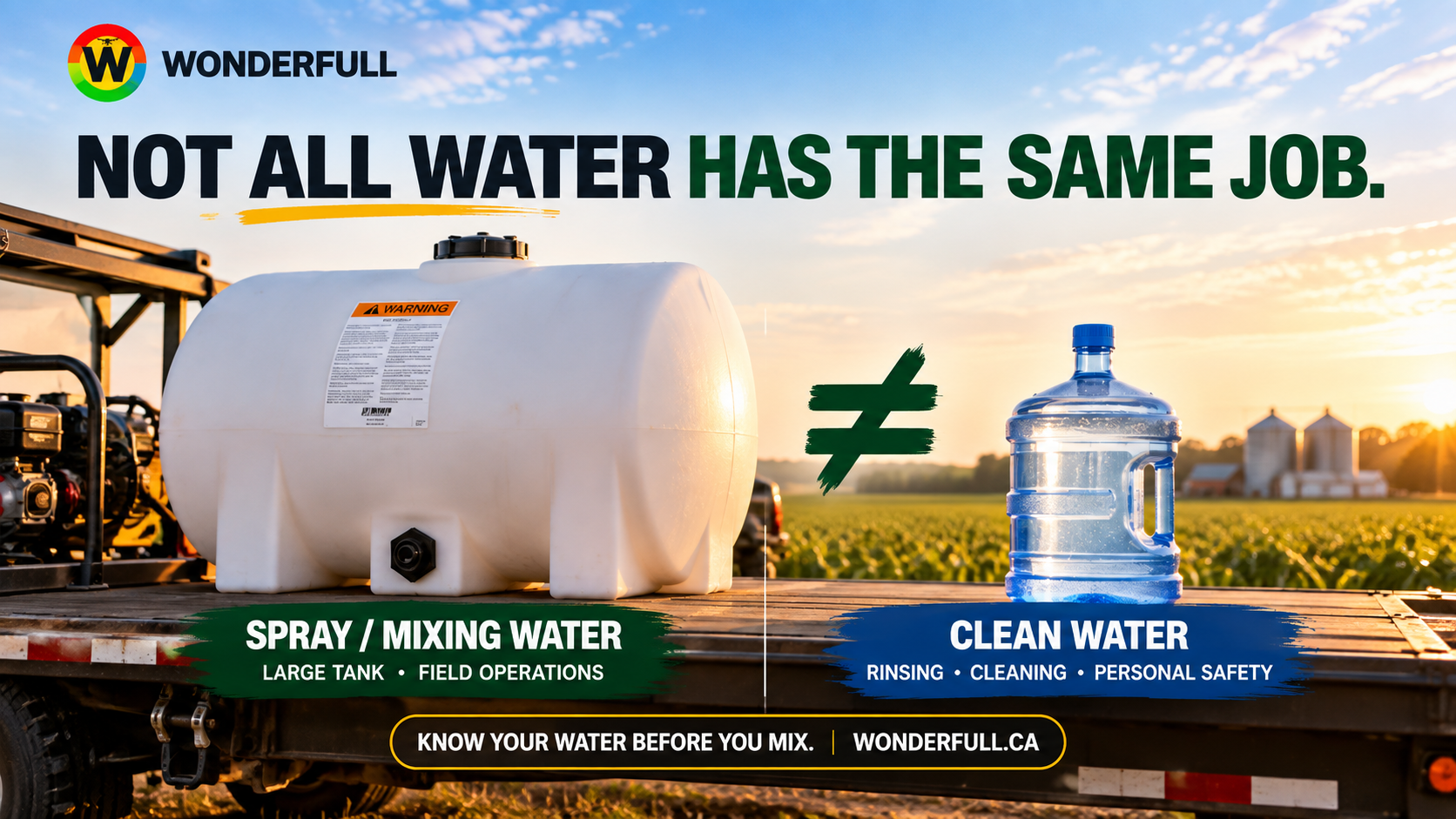
Not all water sources are the same.
Water can vary in pH, hardness, dissolved minerals, and sediment/turbidity, and different pesticides may respond differently to these water-quality characteristics.
A large tank may solve the question of how much water you can carry, but it doesn’t necessarily answer the question of what water you are carrying.
That’s why we encourage agricultural drone operators to develop another habit:
Know Your Water Before You Mix.
We’ll explore water quality and low-volume 2–3 GPA applications in detail in the next article in this series.
Large Tanks Are Convenient — But Think About Cleanout
There is another practical consideration when choosing a tank: cleaning and managing different pesticide programs.
Large tanks have an obvious advantage. They can carry more water or spray solution and reduce the number of times you need to refill.
Smaller tanks, however, may offer more flexibility in some operations. They can be easier to manage, and cleaning may be more practical.
When an operation involves different pesticide programs, the question isn’t only:
“What are we putting in the tank today?”
It is also:
“What was in this tank yesterday?”
Residue may remain not only in the tank itself, but also in pumps, hoses, filters, fittings, and other parts of the transfer system.
Cross-contamination deserves particular attention when moving between herbicides and sensitive crops. Some operations may therefore choose to separate certain tanks or mixing equipment rather than use one system for every application.
Specific cleanout procedures, cleaners, and equipment requirements should always follow the pesticide label and applicable requirements.
This topic is important enough that we’ll dedicate the third article in this series to:
Tank Cleanout & Cross-Contamination.
Sometimes the Best Starting Point Is Already on the Farm
Buying an agricultural drone doesn’t necessarily mean that everything in your ground support system needs to be new on Day One.
Look around the farm first.
You may already have a pickup, flatbed trailer, 200- or 300-gallon tank, mixing tank, pump, hoses, generator, water source, and a chemical-handling system that has been used for years.
If that equipment is appropriate for the intended use and can be operated in accordance with applicable safety and product requirements, it may already provide a good starting point for your agricultural drone operation.
Once you begin working, the real bottlenecks usually become obvious.
If the pump doesn’t provide enough flow, address the pump.
If the hose is too short, change the hose setup.
If batteries don’t have an appropriate location, improve the charging area.
If you’re travelling between multiple farms and your existing trailer can no longer support the operation, then it may be time to consider a more complete mobile system.
You may also discover after a season that you never needed to carry as much water as you originally expected.
These answers can be difficult to predict while sitting in an office designing a trailer.
They usually become very clear in the field.
For Commercial Applicators, the Answer May Be Very Different
If you operate an agricultural drone application business, the role of the trailer changes considerably.
It is no longer simply a trailer carrying a drone.
It can become your mobile operating base.
When you arrive at an unfamiliar farm, you may need to provide your own water, power, mixing equipment, charging system, PPE, tools, spare parts, cleaning supplies, and takeoff and landing area.
In that environment, a carefully designed trailer can significantly improve organization and operating efficiency.
So we’re not saying:
“Don’t use a trailer.”
In fact, as commercial agricultural drone operations continue to grow, we expect purpose-built trailers and mobile support systems to become increasingly sophisticated.
Our point is simply:
Don’t decide what your trailer should look like before you understand how you actually operate.
Operate First. Optimize Second.
Agricultural drones are getting larger. Productivity is increasing. Charging is getting faster, and the ground support systems surrounding these aircraft will continue to evolve.
But after years of field operations, one simple principle still holds true:
The best system isn’t necessarily the one with the most equipment. It’s the one with the smoothest workflow.
Before buying or building an agricultural drone trailer, consider a few practical questions:
How many acres do you actually need to cover in a day? How much water do you really need? Where will that water come from? Where will you mix and clean? Where will batteries be charged? How many times will the operator climb on and off the platform? What equipment do you already have on the farm? And if you’re travelling to another farm, what absolutely needs to travel with you?
Once those questions are answered, the right trailer configuration usually becomes much clearer.
Start with what you have.
Use what you already own, gain real operating experience, and then invest in the equipment that solves an actual problem.
The goal isn’t to own the biggest, most complicated, or most impressive-looking trailer.
The goal is to build an agricultural drone operation that is safe, simple, efficient, and suited to the way you actually work.
Build the trailer around your operation — not your operation around the trailer.
Next in the Series | Know Your Water Before You Mix
Water Quality Matters More at 2–3 GPA
Why isn’t all water necessarily the same when it comes to pesticide application?
In the next article, we’ll look at pH, hardness, dissolved minerals, and sediment/turbidity, and discuss why low-volume agricultural drone operations should consider not only how much water they carry, but also what kind of water they are using.
WONDERFULL INC.
Transport Canada Recognized RPAS Flight School
Certified Advanced Flight Reviewer
Drone Compliance | Academy Training | Sales & Service
Office: 647-800-7952
Text: 647-287-6851
5955 10 Sideroad
Innisfil, ON L0L 1K0
Canada