
The Experience Behind the Technology
Agricultural drones are moving beyond demonstrations and into real farming operations.
And the questions we hear from farmers are changing.
It is no longer simply:
“What can a drone do?”
Farmers want to know whether it actually works for their crop. Can we get the coverage we need? What happens with drift and changing field conditions? Does it still make sense across hundreds or thousands of acres? Is it better to own one or hire an operator?
And ultimately:
Where does this technology actually fit into my farm?
At Niagara Drone Summit, we don’t think those questions should be answered by the drone industry alone.
That is why we are bringing farmers, operators, agronomists, application specialists, researchers and agricultural businesses into the same conversation.
We don’t invite people simply because they can talk about drones.
We invite them because they have experience worth sharing.
Meet some of the people bringing that experience to Niagara.
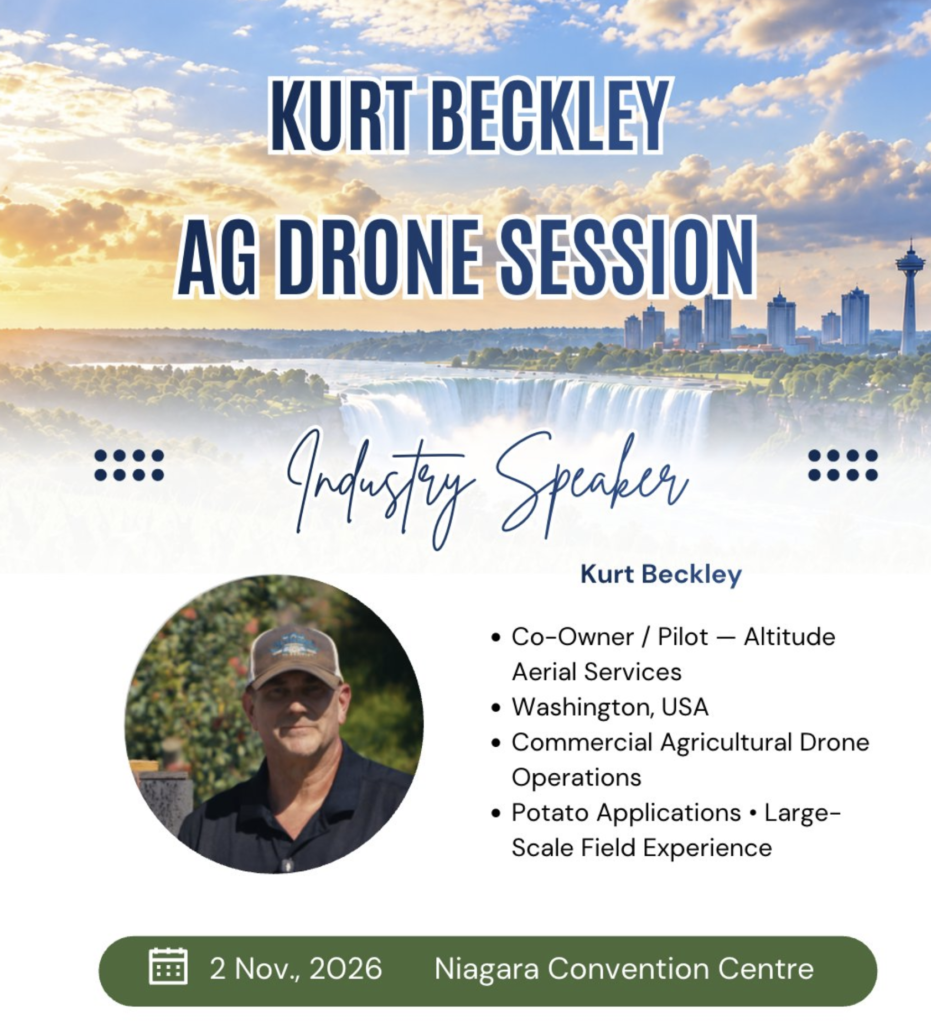
01 | KURT BECKLEY
From Demonstration to Commercial-Scale Application
Altitude Aerial Services | Washington, USA
U.S. Agricultural Drone Operator • Co-Owner
Potatoes • Large-Scale Application • Commercial Drone Operations
What happens when agricultural drones move beyond the demonstration and into large-scale commercial application?
Kurt Beckley brings the perspective of an experienced U.S. agricultural drone operator working in real commercial operations, including potato production and large-scale agricultural application.
For Canadian farmers considering agricultural drones, there is value in hearing from operators who have already spent years putting the technology to work under real field conditions.
The important lessons are not only about what worked.
They are also about what did not work, what had to change, what operators learn as acreage increases, and what a farmer should understand before trying to integrate this technology into a commercial operation.
Why We Invited Kurt
Because Canadian growers should not have to repeat every lesson that experienced operators elsewhere have already learned.
Kurt brings practical U.S. field experience into a Canadian conversation and helps move the discussion beyond what a drone can theoretically do to what happens when the work becomes real.
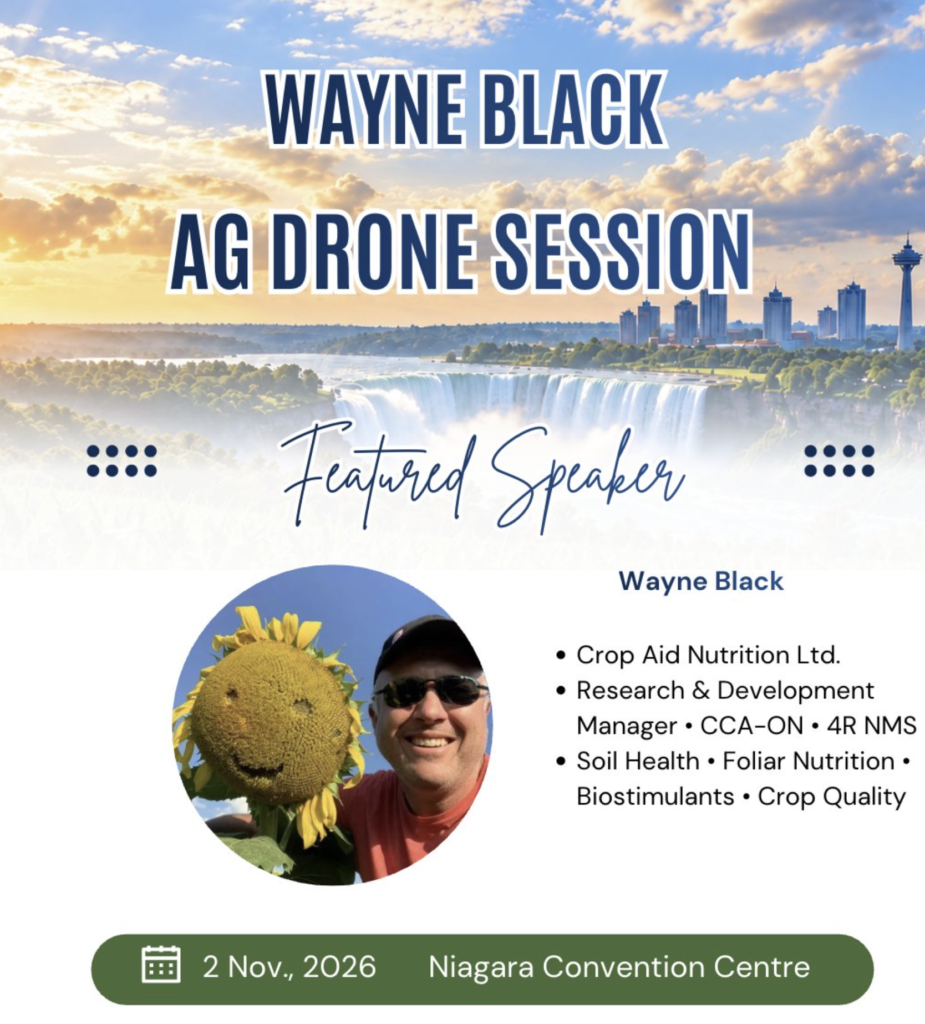
02 | WAYNE BLACK
The Crop Comes Before the Drone
Crop Aid Nutrition Ltd. | Ontario, Canada
Research & Development Manager • CCA-ON • 4R NMS
Soil Health • Foliar Nutrition • Biostimulants • Crop Quality
A drone may be able to apply a product. But what are we applying, why are we applying it, and what are we trying to accomplish in the crop?
Wayne Black brings a very different perspective to the agricultural drone conversation.
His work connects soil health, foliar nutrition, biostimulants and crop quality with the practical decisions farmers make in the field.
That perspective matters because the drone itself is only one part of an agricultural application.
Application technology has to connect back to agronomy, crop conditions, product selection, timing and the result the farmer is trying to achieve.
Why We Invited Wayne
Because agricultural drones should not become an island within agriculture.
The conversation cannot only be about aircraft, batteries, acres per hour and application rates.
It also has to include the crop.
Wayne helps connect emerging application technology back to agronomy and the decisions farmers are already making every season.
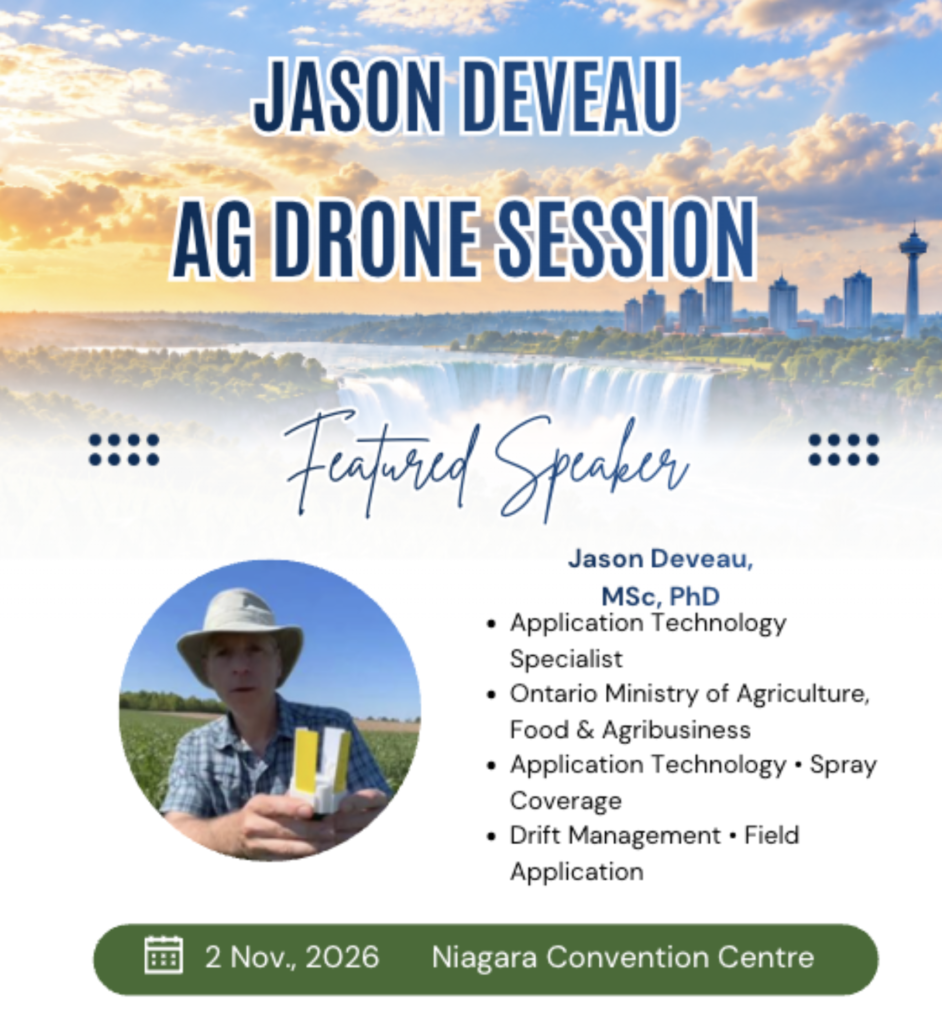
03 | JASON DEVEAU, MSc, PhD
Application Is More Than Putting Droplets in the Air
Application Technology Specialist
Ontario Ministry of Agriculture, Food & Agribusiness
Application Technology • Spray Coverage • Drift Management • Field Application
A drone can put droplets into the air. But did the application actually do its job?
Jason Deveau brings application science into the agricultural drone conversation, with expertise in application technology, spray coverage, drift management and field application.
As agricultural drones become more capable, it is easy to focus on payload, speed, productivity and acres per hour.
But farmers also need to understand what happens between the aircraft and the crop.
Coverage, deposition, droplet behaviour, drift, weather, canopy conditions and application technique can all influence the final result.
Why We Invited Jason
Because faster application does not automatically mean better application.
As agricultural drones move into more Canadian fields, we want the conversation to include independent application knowledge alongside operator experience and technology.
Farmers should be able to ask difficult questions about how an application is actually being made, not simply how quickly a drone can complete the field.
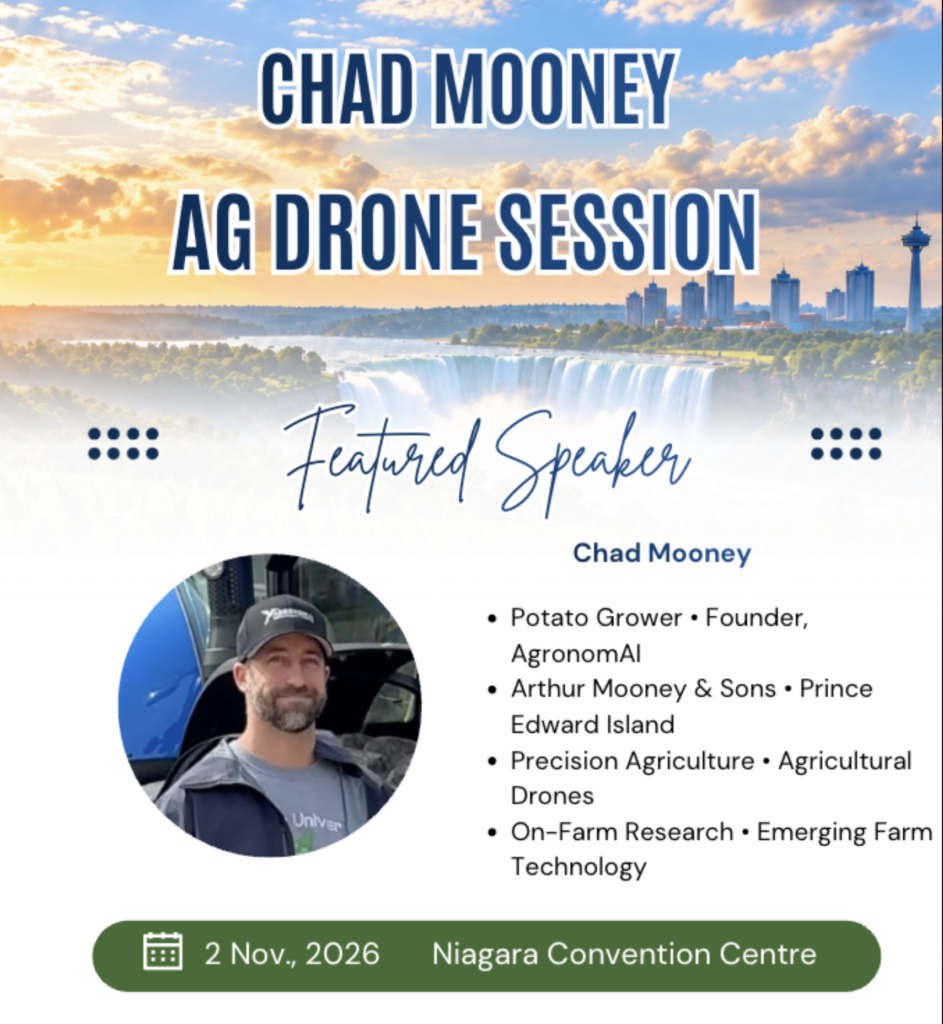
04 | CHAD MOONEY
What Do You Learn After You Actually Start Doing the Work?
U.S. Agricultural Drone Experience
Real Field Operations • Practical Lessons • Operator Perspective
A demonstration can show what an agricultural drone is capable of doing.
Actual field work teaches something different.
Changing weather, different crops, field conditions, productivity expectations, equipment decisions and the small operational problems that appear after hundreds of missions cannot always be reproduced during a demonstration.
Why We Invited Chad
Because some of the most useful knowledge in agricultural drones comes from people who have spent time actually doing the work.
Chad brings another U.S. field perspective to Niagara and adds to the conversation about what operators learn after agricultural drone technology leaves the demonstration field and becomes part of day-to-day operations.
The goal is not simply to talk about successes.
It is to share practical experience, lessons learned and the things another operator or farmer may want to know before encountering the same challenges themselves.
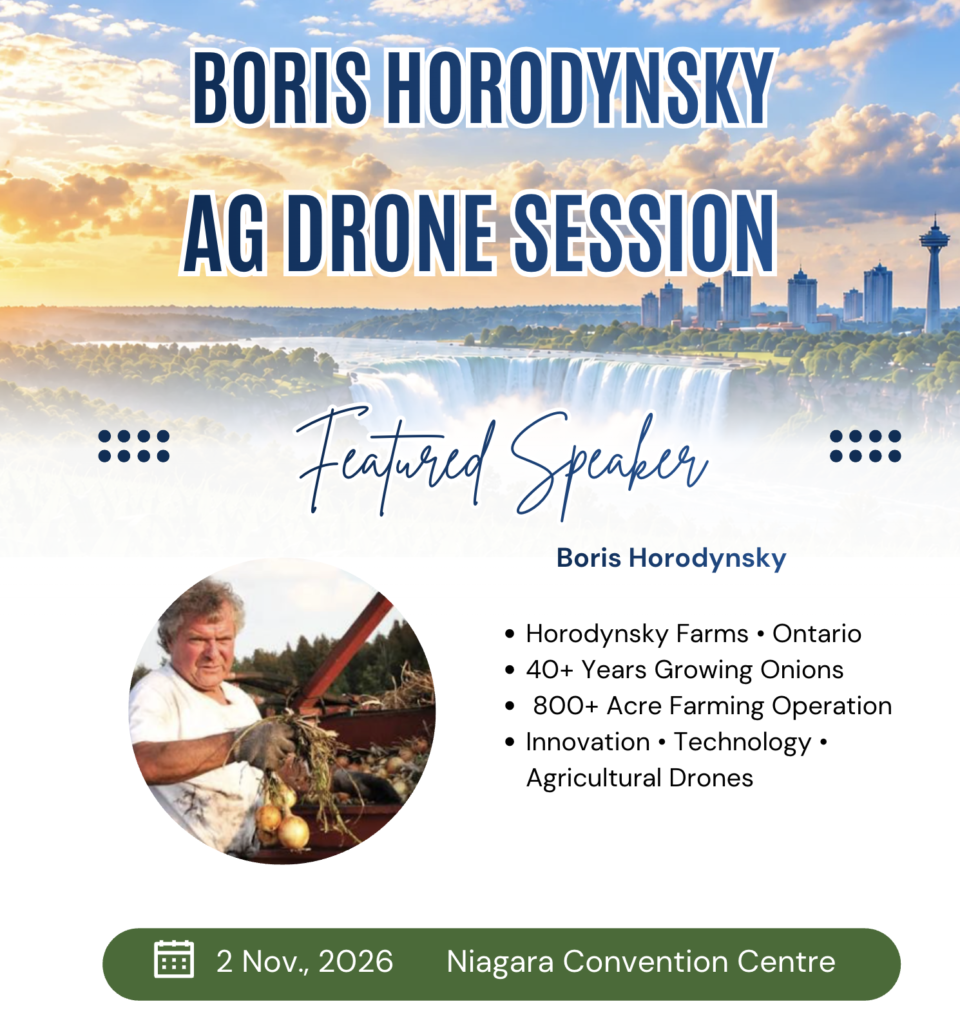
05 | BORIS HORODYNSKY
When a Large-Scale Vegetable Grower Adds Drones to the Toolbox
Horodynsky Farms | Ontario, Canada
Onions • Specialty Crops • Large-Scale Production • Agricultural Technology • Drone Operations
You don’t build one of Canada’s largest onion-growing operations by standing still. So where does drone technology fit into a farm that has been innovating for more than four decades?
Boris Horodynsky brings a very different agricultural perspective to Niagara Drone Summit.
Horodynsky Farms has been producing onions in Ontario for more than 40 years. What began with fewer than 10 acres developed into an operation of more than 600 acres, with multiple locations and an integrated system covering growing, harvesting, storage, washing, packing and distribution.
This is not a farm that is new to technology.
Over the years, Horodynsky Farms has invested heavily in modern equipment, storage and processing infrastructure, and has developed and built machinery of its own. The farm describes innovation and technology as an important part of how the operation has grown.
Agricultural drones became another part of that continuing evolution.
Boris’s use of drone technology has even been recognized publicly in the House of Commons of Canada, where Horodynsky Farms was highlighted as a major Canadian onion operation using drone technology as part of its approach to sustainable farming.
Why We Invited Boris
Because agricultural drones are not only about corn, soybeans and broad-acre crops.
Specialty crop growers face a different set of challenges.
High-value crops, intensive production, field access, application timing, soil conditions and the need to protect crop quality can change the economics of when and where a drone makes sense.
Boris also represents something important to the conversation at Niagara:
A farmer does not have to choose between traditional farm equipment and drones.
A progressive operation can use large conventional machinery, specialized equipment and emerging technologies together, choosing the right tool for the job.
For a grower who has spent more than four decades adopting, modifying and even building equipment to make his operation more efficient, a drone is not the story by itself.
It is simply the next tool worth evaluating.
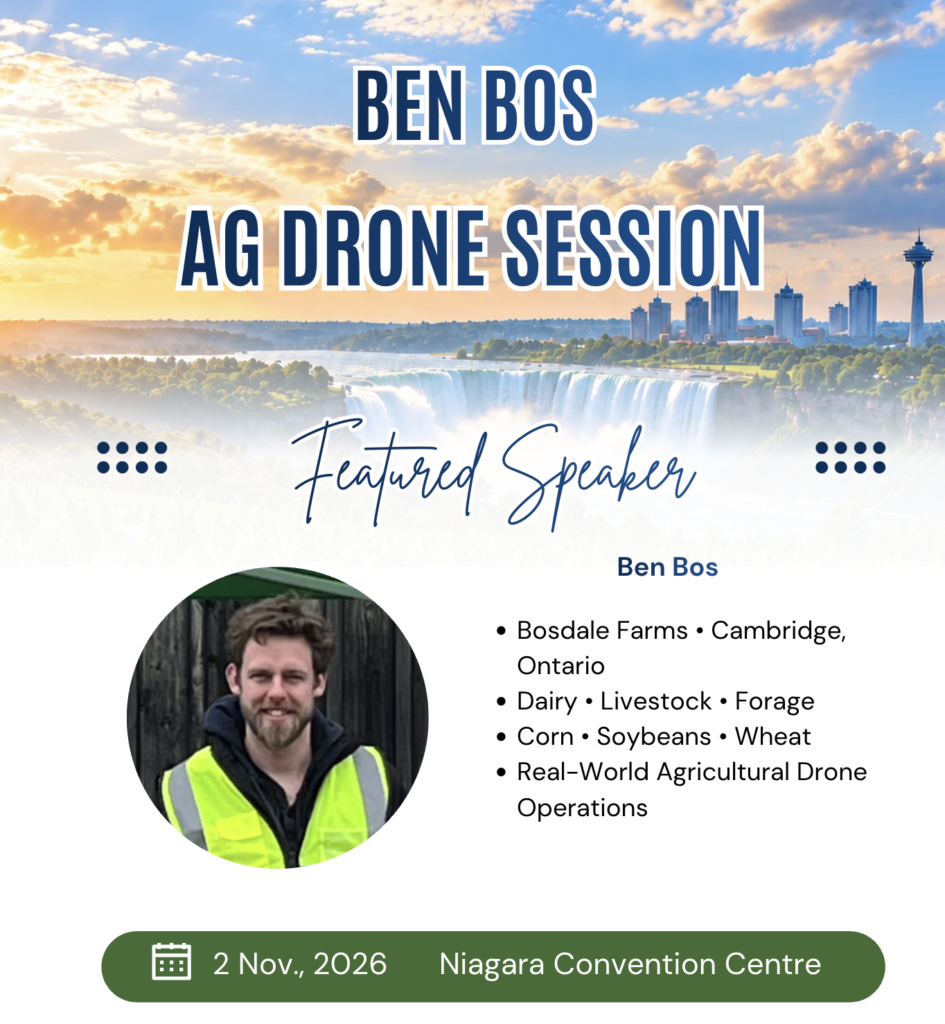
06 | BEN BOS
From Dairy to Field: Where Does a Drone Fit Into a Working Farm?
Bosdale Farms | Cambridge, Ontario
Dairy • Livestock • Forage
Corn • Soybeans • Wheat • Agricultural Drone Operations
A farm already raising livestock, growing forage and producing field crops. Why add agricultural drones to the operation?
That is what makes Ben Bos’s story different.
Ben is not coming to Niagara simply to talk about drone technology.
He is coming as a farmer.
Bosdale Farms is a working Ontario farm where livestock, forage production and field crops are already part of everyday agricultural operations.
Agricultural drones have become another tool within that much larger farming system.
Ben has experience using agricultural drones in real field operations, including corn, soybeans and wheat.
His perspective is particularly relevant to farmers who already have cattle, crops, equipment, labour and an established way of getting work done, and are now trying to understand whether a drone has a practical place within that operation.
Why We Invited Ben
Because farmers considering a new technology often want to hear from another farmer, not only from the company selling the equipment.
Ben can talk about why his farm began using agricultural drones, where they have been useful, what he has learned through actual operation, and what another farmer should consider before deciding whether the technology belongs on their own farm.
This is not about replacing everything a farmer already does.
It is about understanding where another tool may fit.
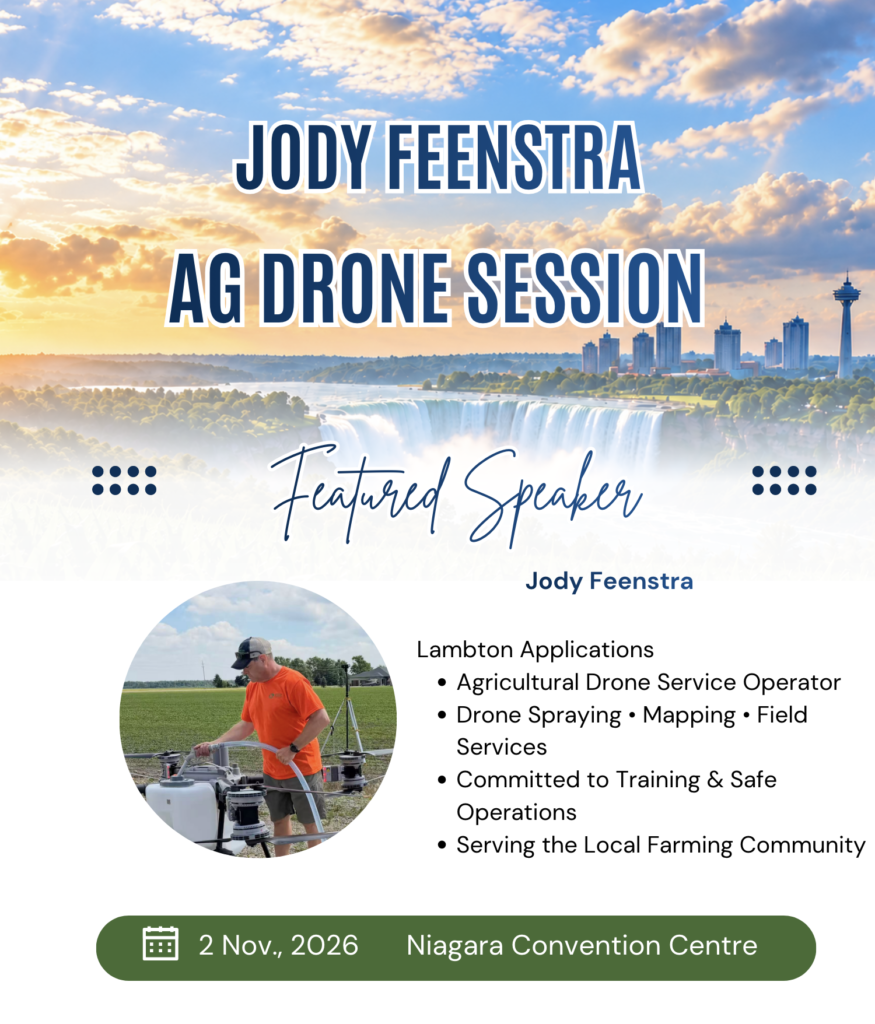
07 | JODY FEENSTRA
From Learning to Service: Building Experience One Season at a Time
Lambton Applications | Petrolia, Ontario
Agricultural Drone Services • Drone Spraying
Field Operations • Training • Safe Application
Jody didn’t start with a farm. He started with a T40, a willingness to learn, and a commitment to providing a responsible service to his community.
That is what makes Jody Feenstra’s story different.
Jody began operating agricultural drones with the DJI Agras T40 and is now entering his fourth season of agricultural drone operations.
He does not own a farm himself. Instead, he chose to learn the technology and develop the knowledge and skills needed to provide agricultural drone services to farmers in his local community.
From the beginning, Jody took that learning process seriously.
Over the years, we have spent many hours with him through phone calls, video support and in-person training. Jody has also made the drive to visit us several times when there were important operational questions he wanted to understand properly.
And learning agricultural drone application is not simply about learning how to fly an aircraft.
Weather, wind, flight height, speed, swath width, droplet size and field conditions can all affect an application. There is rarely one set of parameters that applies to every field and every day.
Understanding why those parameters change is just as important as knowing where to change them on the aircraft.
Jody has continued to build that knowledge season by season, while also working alongside experienced farmers and learning from the people who understand their crops, fields and production systems.
Today, through Lambton Applications, he provides agricultural drone services to his local community while maintaining a strong flight safety record.
Why We Invited Jody
Because agricultural drone knowledge does not come from one place.
Research helps us test and validate technology. Training helps organize and transfer what has been learned. Farmers bring the crop, field and production knowledge that can only come from real agriculture.
A professional operator needs to keep learning from all three.
Jody’s experience shows what that process can look like for someone who did not begin as a farmer: learn the aircraft, understand the principles behind the operation, listen to experienced growers, gain real field experience, and continue improving season after season.
His story is especially relevant to people who are considering agricultural drone services as a profession.
Owning the aircraft is only the beginning. Becoming someone a farmer can trust takes knowledge, experience and responsibility.
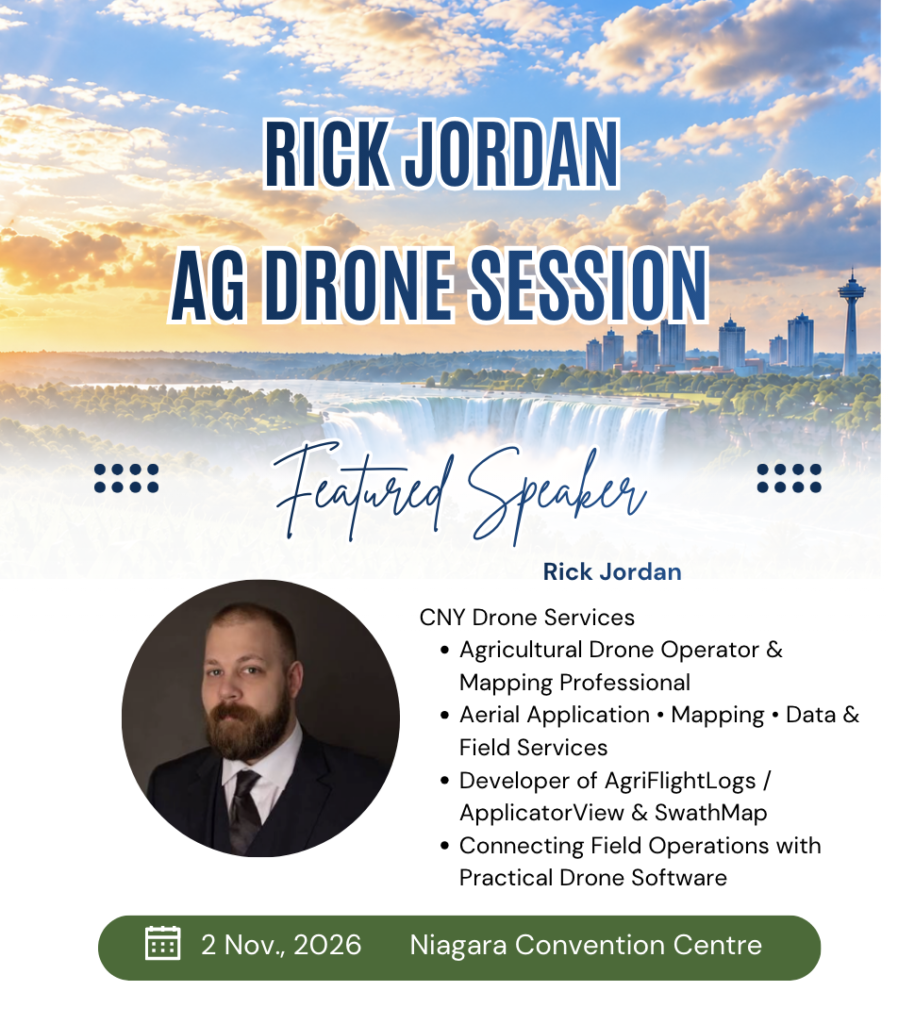
08 | RICK JORDAN
From Moth Control to Better Tools: Solving Real Problems Beyond the Flight
CNY Drone Services | New York, USA
Agricultural Drone Application • Invasive Species Management
Mapping & Field Data • Software & Operational Tools
For Rick Jordan, operating a drone is only one part of the job. The bigger question is whether the technology can solve a real problem in the field.
Rick is the Operations Manager of CNY Drone Services, where his work brings together agricultural drone application, mapping, field operations, invasive species management and software development.
One of those real-world challenges is spongy moth control.
In the U.S. Northeast, invasive spongy moth can create a serious problem for trees and wooded properties. Rick’s work provides a practical example of how agricultural drones can move beyond conventional crop spraying and be used for targeted pest-management applications — particularly in areas where access, terrain or the nature of the application can make conventional equipment difficult to use.
It is the kind of application that raises the questions growers and operators actually need answered:
Where does a drone genuinely offer an advantage? What challenges appear once the aircraft enters the field? And how do you turn a promising technology into a reliable service that customers can trust?
Rick brings more than 10 years of mapping experience to those questions, approaching drone operations from both the aircraft and data sides of the workflow.
And years of field experience have led him to another realization: some of the biggest operational problems aren’t solved by the aircraft at all.
Through projects including AgriFlightLogs / ApplicatorView and SwathMap, Rick has been developing practical tools around challenges operators encounter every day — managing flight and application records, organizing operations, processing field data, and turning maps into information that can actually be used in the field.
This gives Rick an unusual perspective: he doesn’t just operate the technology. He sees the problems around the operation — and works on better ways to solve them.
Why We Invited Rick
Because some of the most valuable lessons in this industry come from solving difficult, real-world problems.
Rick’s experience with spongy moth and invasive species management offers a very different agricultural drone case study: not simply covering more acres, but finding applications where aerial technology can provide access, precision or operational advantages that conventional approaches may struggle to deliver.
At the same time, his mapping and software work shows what happens as a drone operation grows. Planning, application records, field data, compliance and operational organization become just as important as flying the aircraft itself.
Rick brings those worlds together:
real application experience, mapping and data knowledge, and the development of tools inspired by problems encountered in the field.
What You’ll Hear About
-
Real-world spongy moth control by drone
-
Invasive species and specialized application opportunities
-
Where drones can offer advantages over conventional approaches
-
Field challenges and lessons learned from actual operations
-
Mapping, application records and operational data
-
Building better tools around the people who actually fly the missions
-
Turning specialized expertise into a sustainable drone service business
For growers, landowners and operators, Rick’s experience poses a much more interesting question than simply “What can this drone do?”
What problems can we solve with it that were difficult to solve before?
ARE THESE YOUR QUESTIONS TOO?
If you’re a farmer, grower or agricultural operator, you may be asking:
Can agricultural drones really work at commercial farm scale?
Where does a drone actually fit into an existing working farm?
How do I know the application is actually being done properly?
The drone can apply it, but should I apply it this way, and what result am I trying to achieve?
What will I discover after I actually start doing the work?
I already have specialized equipment and an established farming system. Where can a drone do something my existing equipment cannot?
Bring your questions to Niagara.
These are some of the questions we want to talk about at Niagara Drone Summit, with farmers, operators, agronomists, application specialists and others who have real experience to share.