
From Pesticide Labels and Temperature Inversions to Drone Spray Drift and Application Safety
August 30, 2026
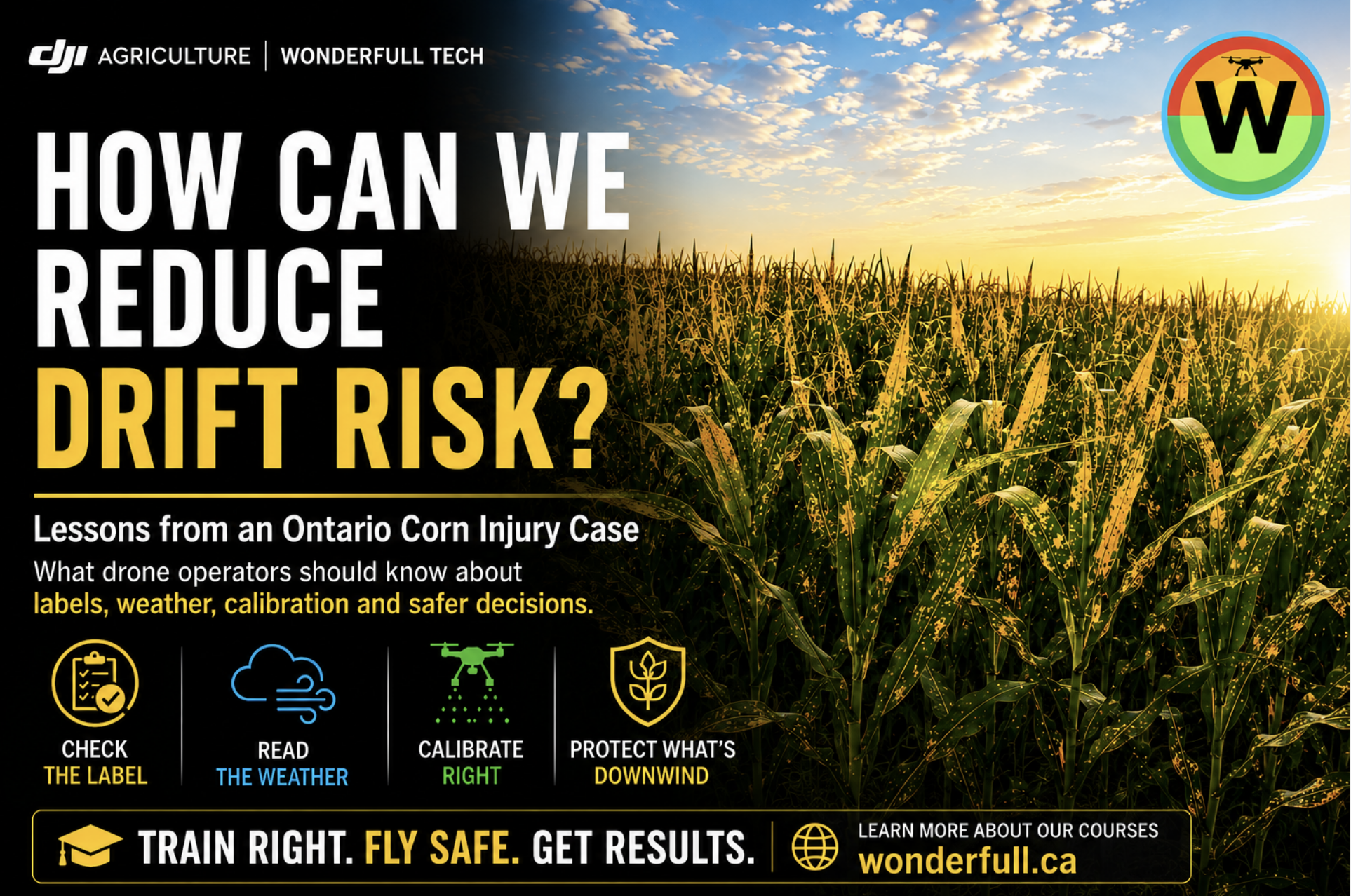
Recently, an Ontario grower shared a photo with us showing significant injury to his corn.
According to the grower, a neighboring field was being sprayed by an agricultural drone at night as part of a canola application. Afterward, he noticed extensive leaf burn, yellowing, and necrotic tissue in his corn.
Based on the photo, some of the symptoms appear consistent with contact-type injury.
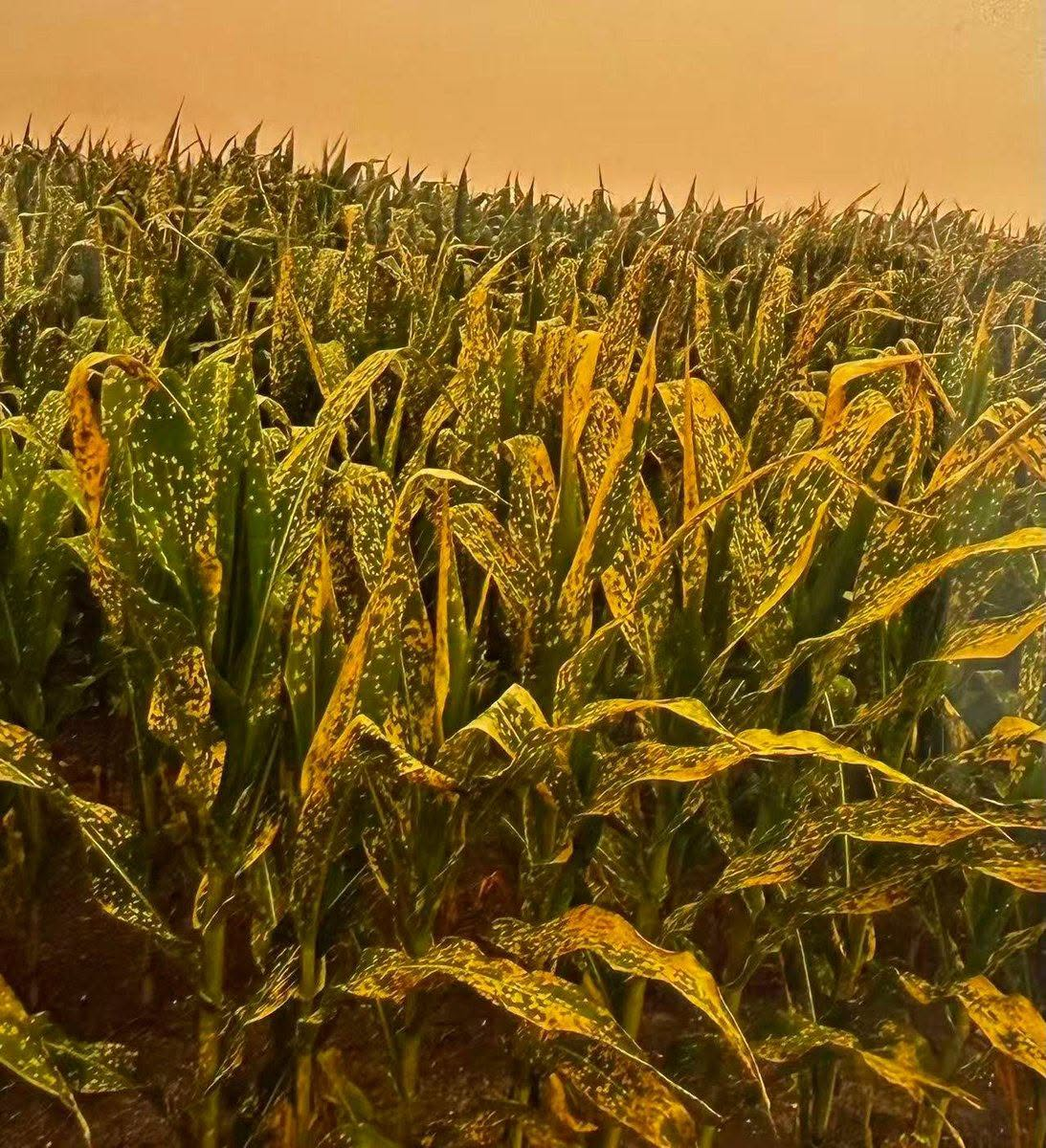
The image also generated discussion among agricultural application professionals.
After seeing the photo, Auburn University Professor Steve Li commented:
“Paraquat can do this easily.”
Others suggested that the symptoms could potentially be associated with contact herbicides such as paraquat or diquat. Given that the case occurred in Ontario and the neighboring crop was canola, some also raised diquat as a possibility.
At the same time, others pointed out that the photo alone cannot rule out fungal disease or other biotic causes.
And that is exactly why this case is worth discussing.
A photo can provide clues. It cannot replace a proper investigation.
We do not know which pesticide product was actually applied in the neighboring field. We also do not have the complete application records, drone settings, weather data, or a detailed map showing the relationship between the affected area and the wind direction at the time of application.
For that reason, this article does not attempt to determine the product involved, the cause of the injury, or responsibility for the incident.
But the case raises an important question for Canada’s rapidly growing agricultural drone industry:
If you are not sure whether a product can legally be applied by drone, whether tonight is actually a safe time to spray, or whether your settings may increase drift risk—should you really be taking off?
01 | Label First: Not Every Pesticide Can Go Into a Drone
On June 30, 2026, Health Canada released SPN2026-02, allowing RPAS—Remotely Piloted Aircraft Systems—to apply pest control products that are already registered for conventional aerial application.
This was an important development for agricultural drones in Canada.
But it is also easy to misunderstand.
Canada allowing pesticide application by RPAS does NOT mean every pesticide can now be applied by drone.
The first place to look is the current product label.
If the label permits aerial application and does not contain additional restrictions that prohibit RPAS use, the applicable aerial label directions must still be followed.
That includes requirements such as:
Application Rate · Spray Volume · Droplet Size · Spray Buffer Zones · Other Label Directions
If the label says:
“DO NOT apply by air”
or the product is not approved for aerial application, the fact that you own an agricultural drone does not change how that product can legally be applied.
That is why we emphasize a very simple principle:
Label First. Parameters Second.
Several people discussing this Ontario case mentioned paraquat, while others suggested diquat.
We cannot confirm which, if either, was involved.
But paraquat provides a useful example of why checking the label comes before discussing drone settings. Health Canada regulatory information for Gramoxone 200 SL specified “groundboom applications only.”
The broader lesson is more important than the name of any one product:
If a product is not permitted for aerial application, no combination of lower altitude, slower speed, larger droplets, or favorable weather can turn an unauthorized application into a compliant one.
So when an operator receives a spray job, the first question should not be:
“How high should I fly?”
It should be:
“Can this specific product legally be applied this way?”
02 | No Wind ≠ No Drift: Calm Nights Can Still Carry Risk
There is another important detail in this case:
The grower told us the neighboring drone application took place at night.
We do not have complete meteorological data from that evening, so we cannot determine whether a temperature inversion was present, nor can we conclude that an inversion caused the reported crop injury.
But temperature inversions are an important risk that agricultural drone operators need to understand.
There is a common assumption:
It’s cooler at night, humidity is higher, and the wind is calm—so nighttime spraying must be safer.
Not necessarily.
Under clear, stable conditions with very light winds, the ground can cool rapidly after sunset. Air close to the surface may become cooler than the air above it, creating a stable layer near the ground.
Vertical air mixing becomes weak.
If the spray contains a significant proportion of fine droplets, those droplets may remain suspended instead of settling quickly into the target canopy. Even very light horizontal air movement can then carry them away from the intended application area.
That is why operators should remember:
NO WIND ≠ NO DRIFT.
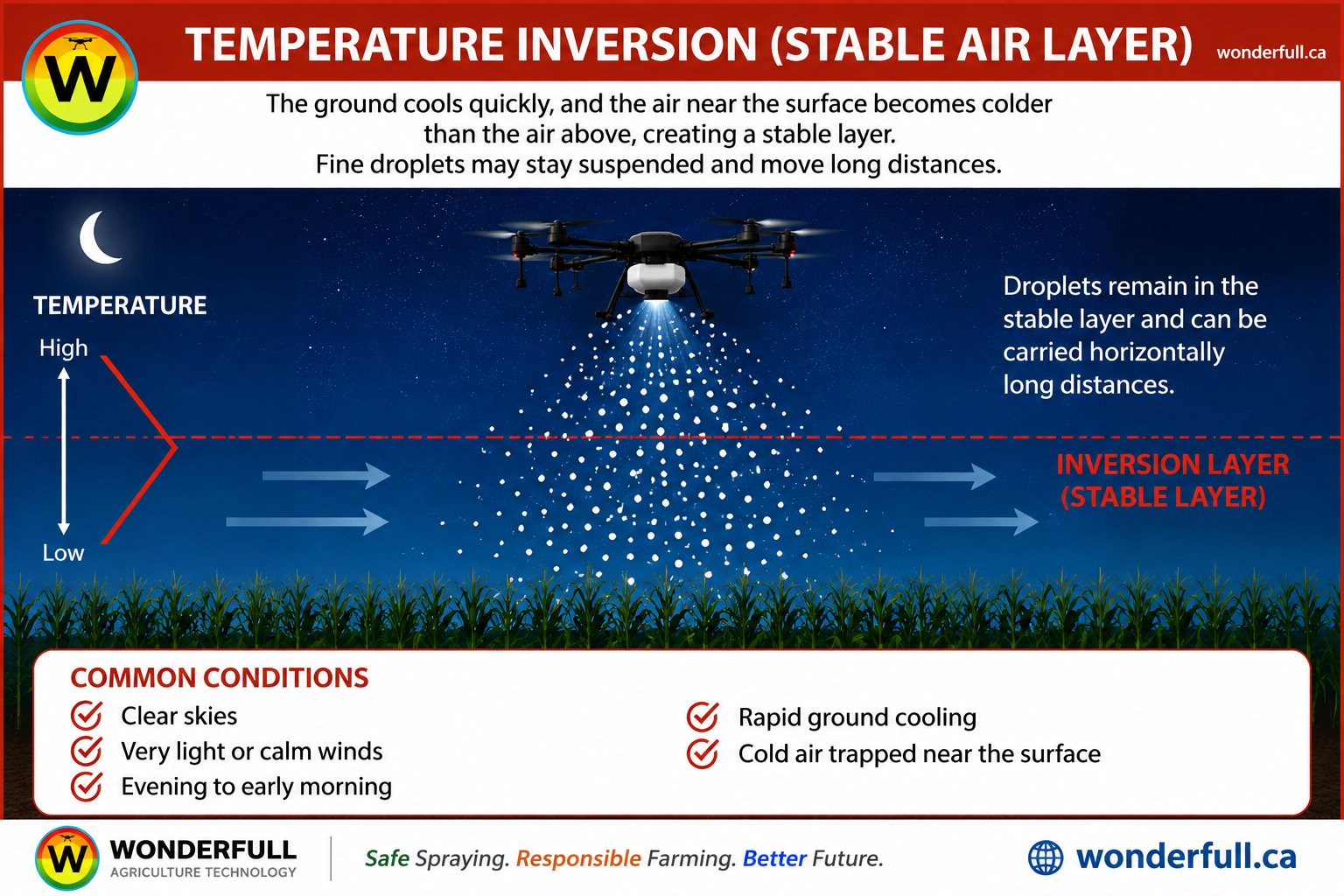
A weather decision should not be based on a single wind-speed number in a phone app.
Where is the wind coming from?
Are there gusts?
What are the temperature and humidity doing?
Is the atmosphere stable?
What is downwind?
And what is farther beyond the field boundary?
Those questions can matter more than one number on a screen.
If you are not confident that conditions are suitable, being conservative is usually better than risking another grower’s entire season just to finish a few more acres tonight.
03 | Drift Risk Is Rarely About One Setting
One of the most common questions in agricultural drone application is:
“Just tell me the right altitude, speed, and droplet size.”
Unfortunately, spray application does not work that way.
Actual spray performance depends on a combination of factors:
Droplet × Height × Speed × Swath × Volume × Weather
Change flight height, and you change the distance and time droplets travel before reaching the canopy.
Change speed, and you may change the interaction between rotor downwash, the spray cloud, and the crop.
Change the droplet spectrum, and you may change the balance between coverage and drift potential.
Set the wrong swath width, and you can create overlap or gaps.
In other words:
Agricultural spraying is not simply entering a few numbers into an app and pressing Start.
The better question is:
Why are you using these settings today?
And an even more important question is:
Have you verified what those settings actually produce?
Health Canada’s 2026 RPAS policy specifically emphasizes proper calibration, spray performance, effective swath width, and drift mitigation.
This is also why we intentionally do not publish a single set of “universal drone spray settings.”
Professional application requires considering the relationship between:
Product + Crop + Target + Aircraft + Atomization System + Weather + Surroundings
Different equipment, products, crops, and operating environments may require very different decisions.
The real risk is not simply that you do not know a parameter.
It is not knowing—and assuming that you do.
04 | Before You Fly, Ask Yourself a Few Questions
This article is not intended to be a complete agricultural drone application manual.
But before conducting an RPAS pesticide application in Canada, there are several questions worth asking.
Does the current label for this specific product permit aerial/RPAS application?
Are the crop, target, application rate, spray volume, and droplet requirements consistent with the label?
What is actually downwind today?
Could current atmospheric conditions increase the risk of off-target movement?
Were your height, speed, droplet, flow, and swath settings selected because “that’s what everyone uses”—or because you have actually verified their performance?
If conditions change during the operation, do you know what needs to change with them?
And there is another question that new operators sometimes overlook:
Who is flying, and who is mixing and loading?
Health Canada’s 2026 RPAS guidance addresses the responsibilities of the pilot, mixer/loader, and visual observer.
Unless the specific product label states otherwise, the person mixing and loading the pesticide must be different from the RPA pilot.
Crew configuration, PPE, closed-transfer procedures, equipment handling, and cross-contamination are all part of a professional spray operation.
Even something as simple as:
Using pesticide-contaminated gloves to operate a clean remote controller
can create unnecessary exposure and cross-contamination.
Professional pesticide application involves managing the entire operation—not just the few minutes the drone is in the air.
05 | Knowing How to Fly Is Not the Same as Knowing How to Spray
Let’s return to the Ontario corn case.
From one photograph, we cannot determine:
Exactly which product was involved.
We cannot determine:
Exactly how the injury occurred.
And without a complete investigation, we cannot determine:
Who, if anyone, was responsible.
But the case still provides an important lesson for the industry.
A drone application may take only a few minutes. The consequences of one poor decision can last an entire growing season.
Better technology does not automatically produce safer applications.
A newer, larger, or more automated agricultural drone cannot make the most important decisions for the operator:
Judgment.
Is this product permitted?
Are today’s conditions appropriate?
What is downwind?
Can the risk be managed?
Why am I using these settings?
And if conditions change, should I continue, adjust—or stop?
These are the skills that separate simply flying a drone from conducting a professional pesticide application.
When You’re Not Sure, Don’t Rush the Decision
That may be the most important lesson from this case.
Not sure about the label? Verify it first.
Not sure about the weather? Wait.
Not sure about your settings? Validate them.
Not sure about the downwind risk? Don’t take off yet.
Losing a little time may affect today’s productivity.
A poor application decision could affect someone else’s crop for the rest of the season—and potentially create complaints, financial losses, liability, and loss of trust in the technology itself.
Slow Down. Verify. Then Fly.
This is also an important part of what we teach through Wonderfull Academy’s Agricultural Drone Application Training.
Our goal is not simply to give operators a few numbers to memorize.
Aircraft change.
Products change.
Weather changes every day.
What matters is developing the ability to make the right decision for the situation in front of you.
If you are preparing to conduct agricultural drone applications in Canada and still find yourself asking questions such as:
Can I legally apply this product with an RPAS?
How should droplet size, flight height, speed, flow rate, and swath work together?
How do I evaluate whether today’s weather is worth the risk?
How do I verify the actual spray pattern of my aircraft?
How should the pilot, mixer/loader, visual observer, PPE, and workflow be organized?
Those questions usually cannot be solved by copying a few settings from the internet.
Talk to the Wonderfull team about your specific application scenario.
We would rather understand your crop, product, aircraft, application objective, and operating environment before discussing what makes sense for your operation.
Because professional agricultural drone application is not simply knowing how to take off.
It is knowing:
When NOT to fly.
Not Sure About Your Application? Talk to Us.
If you already own or operate an agricultural drone but still have questions about pesticide application, spray system setup, calibration, operating parameters, or how weather and surrounding conditions should influence your decisions, you are always welcome to talk with the Wonderfull team.
We do not believe in simply giving operators a set of “standard settings,” because agricultural application rarely comes down to one set of numbers that works everywhere. Rather than immediately telling someone how high to fly or how fast to operate, we prefer to first understand the crop, product, aircraft, application objective, and operating environment, and then look at what actually matters for that particular operation.
Agricultural drones are highly practical tools. When used properly, they can improve efficiency and help growers complete applications in situations where conventional equipment may be less practical. But like any capable piece of agricultural equipment, the more the technology can do, the more important it becomes for the operator to understand how to use it properly.
Wonderfull has been involved in drone training for the past eight years. From our early years with DJI Academy to today’s Wonderfull Academy, our training has continued to evolve alongside the technology, regulations, and real-world agricultural applications.
Along the way, we have brought together aviation safety and regulatory knowledge based on Transport Canada requirements, the technical experience developed within our own team, and lessons learned through years of working directly with growers in real farming environments.
Learn more about the history of Wonderfull Academy
Those years of experience have reinforced something we believe is very important: agricultural drone training should not be about memorizing as many settings as possible, and learning to fly the aircraft is only part of the job.
For growers, the goal is much more practical:
Reduce avoidable incidents, avoid unnecessary mistakes, use the equipment properly, and achieve more consistent results in the field.
This becomes especially important with pesticide application.
Real field conditions do not always match a textbook example. Products change. Crops are different. Weather changes throughout the day. Sensitive crops may be nearby, and aircraft configuration, field conditions, and application objectives can vary from one job to the next.
That is why operators need more than the ability to know what to set. They also need to understand why those settings make sense, what factors may change the decision, and when the original plan should be reconsidered.
Sometimes spending a few extra minutes checking the product label, reviewing the weather, or verifying an aircraft setting may slow the operation down.
But in agriculture, a few extra minutes are usually far less costly than an avoidable application incident.
We also do not want cases like the Ontario corn injury discussed in this article to leave growers with the impression that agricultural drone spraying itself is unsafe. That is not the point.
We share cases like this because understanding where risk comes from is one of the best ways to manage it. With the right knowledge, preparation, equipment setup, and judgment, operators can make better decisions and reduce unnecessary risk.
Good technology works best when it is understood and used properly.
For a grower, the real value is not simply owning a more capable agricultural drone. It is being able to use that technology safely, reliably, and effectively in your own operation.
If there are still parts of agricultural drone application that you are unsure about—how to set up your spray system, how different operating parameters work together, how to calibrate your aircraft, how to evaluate weather and environmental conditions, or simply where to begin with a particular application—you are welcome to bring your real-world questions to us.
Our first goal is not simply to give you an answer. It is to help you understand the problem well enough to make a better decision.
Because professional agricultural drone operation is not only about knowing when you can fly. Sometimes it means slowing down, checking one more time, or recognizing that the better decision is to wait.
That helps protect more than the aircraft. It helps protect your crop, your customers’ crops, neighboring farms, and the reputation and business you have worked hard to build.
WONDERFULL INC.
Transport Canada Recognized RPAS Flight School
Certified Advanced Flight Reviewer | Drone Compliance | Academy Training | Agricultural Drone Sales & Service
Office: 647-800-7952
Text/WhatsApp: 647-287-6851
5955 10 Sideroad, Innisfil, ON L0L 1K0, Canada