
For growers, whether the job is done with a high-clearance ground sprayer, a conventional aircraft, or an agricultural drone, the goal is ultimately the same: make the right crop-protection application at the right time and grow the best crop possible.
The problem is that farming rarely gives us perfect application conditions.
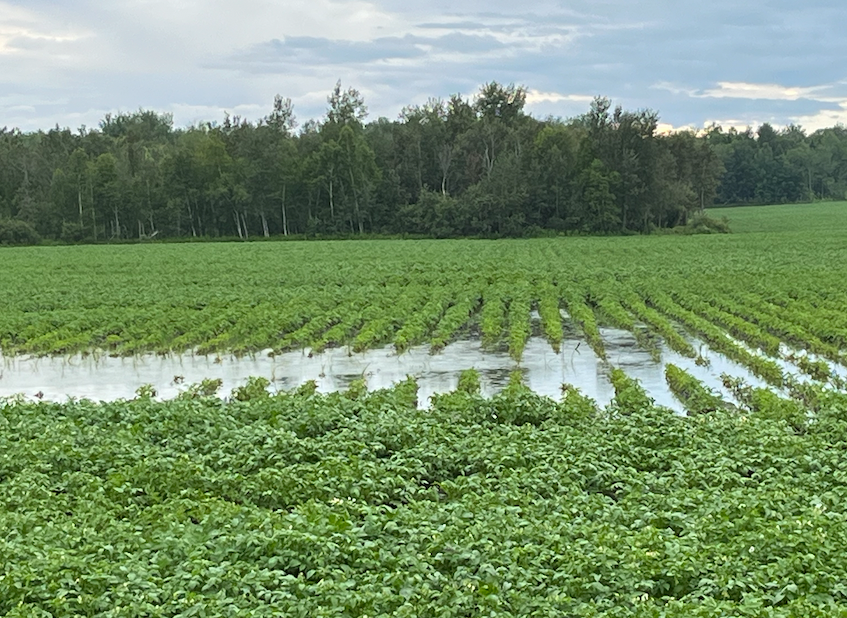
After working with more growers across Canada, we have started to look at agricultural drones from a slightly different perspective.
Instead of asking whether drones can replace ground sprayers, perhaps there is a more practical question:
When the crop needs attention but conventional equipment cannot get into the field, does the grower have another option?
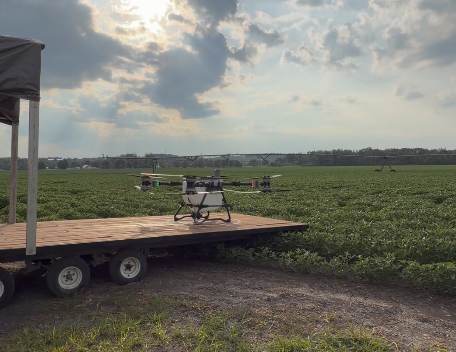
That may be where agricultural drones are most worth considering.
The Crop Is Ready. The Ground May Not Be.
One Canadian potato grower we have worked with started using drones many years ago.
At first, the drone had nothing to do with spraying. It was simply a way to see what was happening in the field.
During one potato season, the grower encountered a serious emergence problem. It was obvious from the ground that something was wrong, but it was difficult to understand the scale of the problem across the entire field.
Aerial imagery changed that. For the first time, the grower could see the issue at the field scale. Publicly available reporting from the time documented that the imagery helped identify losses affecting approximately 2/5 of the planted area and provided important evidence for investigating the source of the problem.
Back then, the drone helped the grower see the problem.
Years later, drones began taking on another role: helping protect the crop.
The reason was practical. Some of the potato ground involved heavier soils. After rainfall, large spraying equipment could not always enter the field when an application was needed. Even when it could, repeated traffic from heavy equipment could contribute to soil compaction and field disturbance.
The crop-protection window, however, was still moving.
Over time, the grower incorporated drones into the crop-protection program and now uses two agricultural drones for crop-protection applications. Agricultural media reporting on the operation has also noted the role of drones in reducing soil compaction associated with heavy equipment.
We have heard essentially the same concern from potato growers in Ontario. When rainfall is heavy, large equipment may also be unable to get into the field at the right time.
The starting point for all of these growers is the same.
They are not using drones simply because they want to use drones, nor are they trying to prove that one machine is more advanced than another.
They are trying to grow the best potatoes they can.
If a ground sprayer can efficiently do the job that day, use the ground sprayer. But if the ground is not ready and the crop is, a drone may give the grower another option.
That brings us to one of the most important words in this discussion:
Timeliness.
Getting Into the Field Is One Thing. Can the Spray Get Into the Canopy?
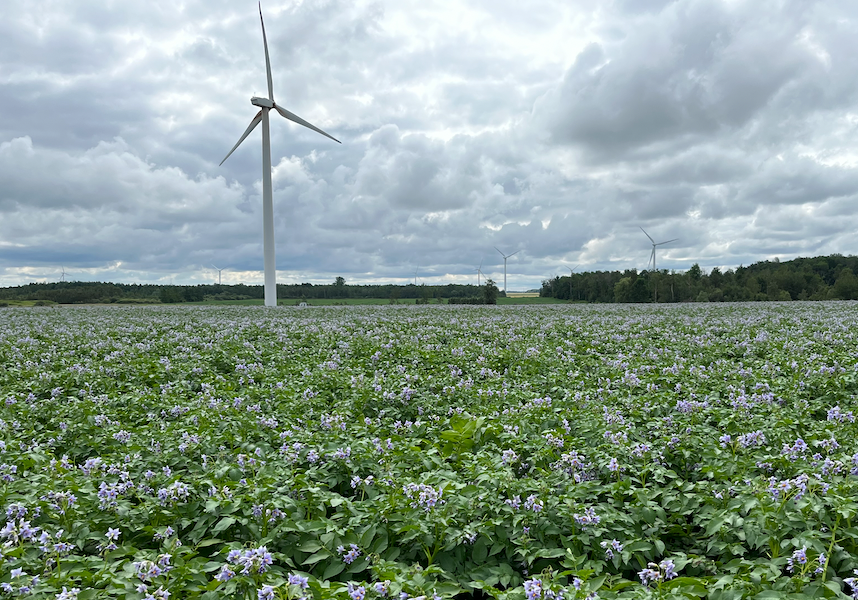
That was one of the biggest questions during a potato field demonstration we participated in in Ontario.
In August 2023, the potato canopy was already well developed. Standing beside the field, you could see layers of dense foliage.
The question from growers was straightforward: if a drone is spraying from above, at a much lower carrier volume than a conventional ground sprayer, can the droplets actually reach the lower canopy?
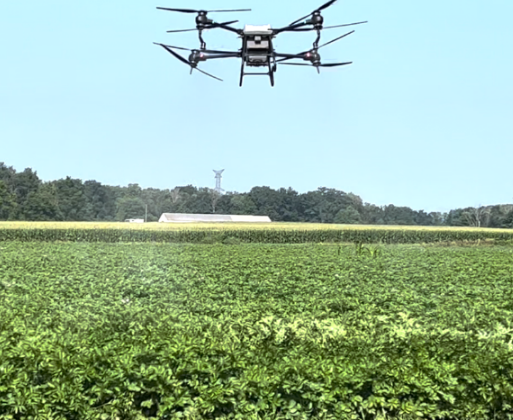
The application covered 13.05 hectares, or 32.3 acres, using a total spray volume of 268.99 litres. The average application rate was approximately 2.2 gal/acre.
To evaluate what was actually happening inside the canopy, the agronomist on site did not place water-sensitive paper only at the top of the plants. Cards were positioned deep within the potato canopy, including locations close to the lowest leaves.
That detail mattered.
If the cards had only been placed on top, good results would simply show that spray had reached the crop surface. That was not what everyone really wanted to know.
The question was:
What is happening at the bottom?
After the application, we went back into the field and collected the cards from different canopy positions.
The results were encouraging. Even on cards positioned in the lower canopy, we could clearly see droplet deposition.
That does not mean the same result will occur under every condition. Flight height, speed, droplet size, application rate, spray system, weather, crop stage and canopy density can all influence deposition.
But under the conditions and parameters of that particular application, we could see that the spray had not simply remained on the upper leaves. Droplets had moved into the canopy.
For the growers and agronomist standing in the field, that meant much more than simply being told that a drone has “good canopy penetration.”
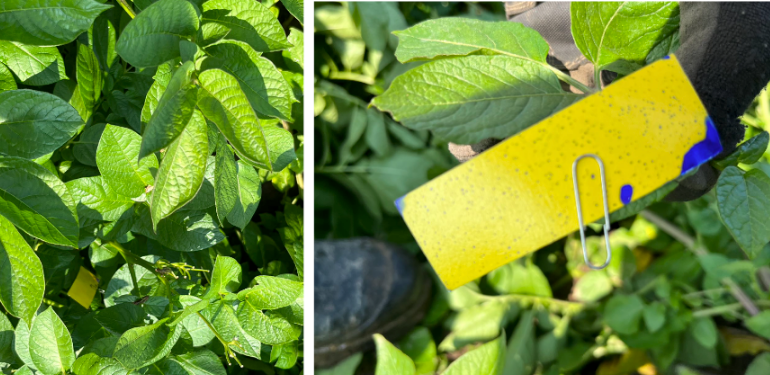
They could see the result for themselves.
Onion Growers Have Been Asking the Same Question
Later, while talking with Ontario Holland Marsh onion grower Boris Horodynsky, we realized that he had been thinking about essentially the same problem.
Boris has grown onions for decades. He told us that every year during crop-protection applications, one concern remains: is the product actually getting down into the plant where it needs to be?
As onions develop, the canopy becomes increasingly dense. Effective disease management is not only about covering the most visible upper surfaces. Protection may also be needed deeper in the plant, including lower leaves and the areas between the leaves and stems.
This was one of the things Boris paid close attention to when he began working with agricultural drones.
Based on what he has observed in his own fields, the downward airflow and turbulence generated by the rotors disturb the foliage and help carry droplets deeper into the plants. He has seen spray reach the lower leaves and the areas between the leaves and stems, with results he has been very pleased with.
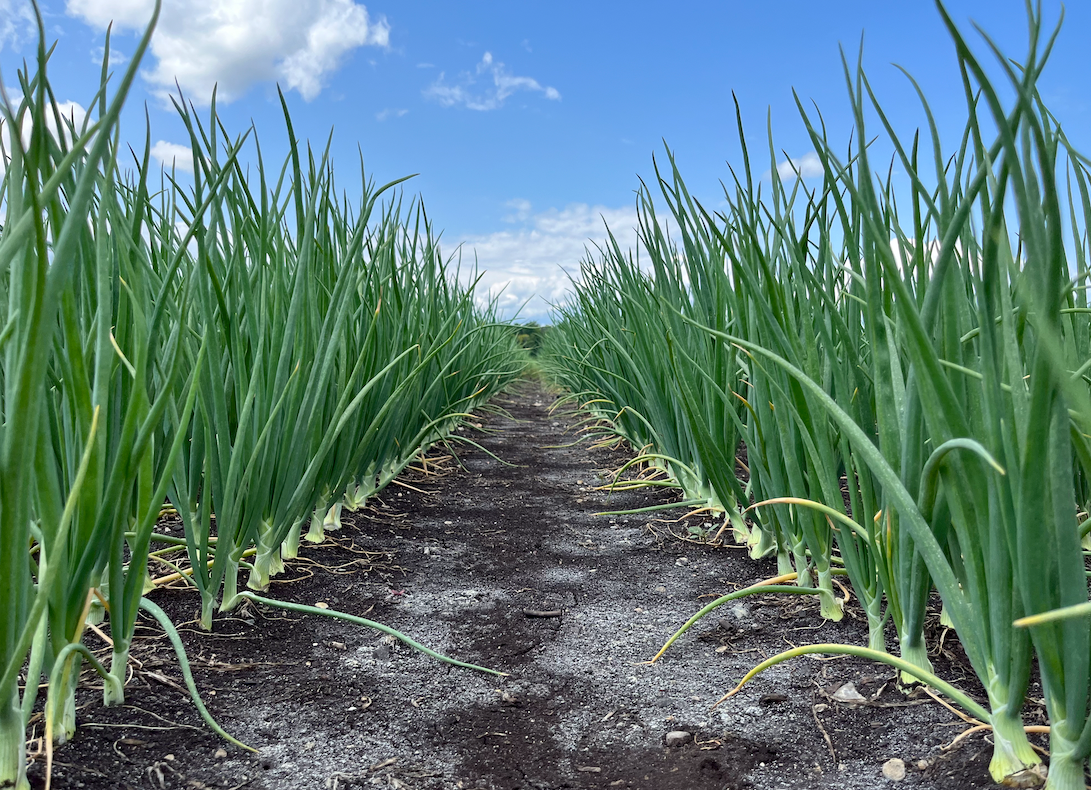
What he described was remarkably similar to what we later saw on the water-sensitive paper in the potato canopy.
Different crops—onions and potatoes—but the grower is asking exactly the same question:
Did the product reach the part of the crop that actually needed protection?
Public information about Boris’s operation also shows a long history of adopting agricultural technology, including the use of agricultural drones for crop protection.
But something else Boris shared with us left an equally strong impression: he does not think about crop protection as an isolated spraying operation.
A Good Onion Doesn’t Start in the Storage Building
At one point, a grower from outside the area drove roughly eight hours to visit Boris. He wanted to understand how Boris successfully stores onions through the Canadian winter.
It is an important question. Harvest is only one stage of onion production. The crop may then spend months in storage before reaching the market.
The visiting grower was understandably interested in storage temperature, humidity and building management.
Boris’s answer went further.
Temperature and humidity in storage are certainly important, but whether an onion stores well is not determined only after it enters the building.
A lot of that work has already happened before the crop reaches storage.
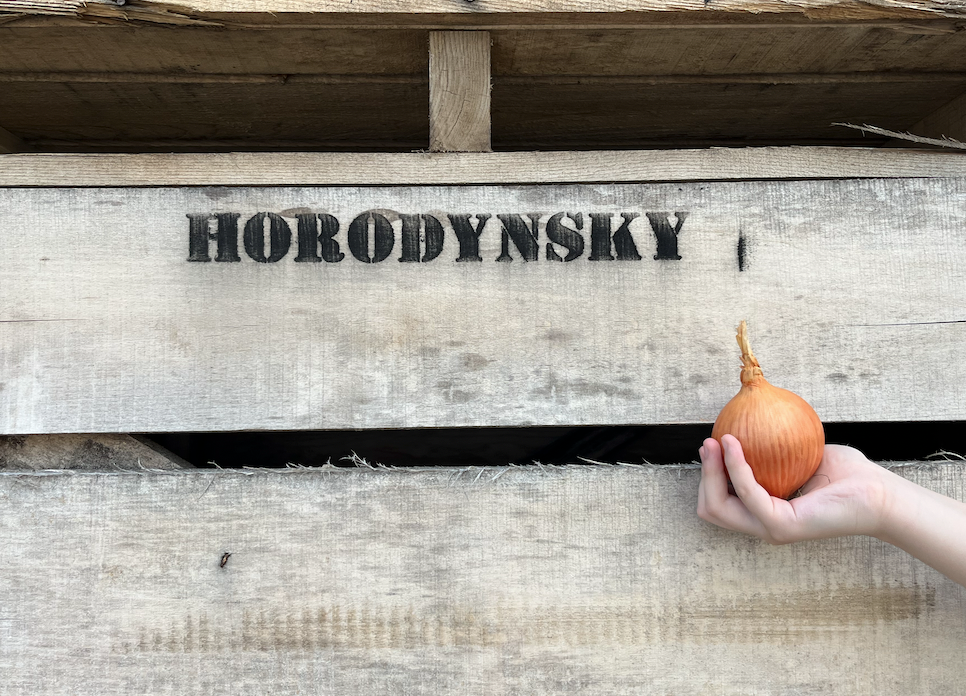
Disease management in the field, the health of the crop approaching harvest, and appropriate fungicide work before storage can all influence what happens afterward.
That conversation brought us back to the crop itself.
We are not interested in canopy penetration because rotor downwash sounds impressive. We are not interested in application timing simply because a drone may move faster than a tractor.
The objective is much more practical:
When the crop needs protection, do the job properly.
At 2.2 gal/acre, How Were Droplets Reaching the Lower Leaves?
Going back to the Ontario potato demonstration, there is an obvious question.
Compared with many conventional ground applications, 2.2 gal/acre is a low carrier volume. So why were we still seeing droplets on cards in the lower canopy?
A spray drone does not interact with the crop in exactly the same way as a conventional boom sprayer. As the aircraft moves over the canopy, droplets are not simply falling under gravity. Rotor downwash also influences how droplets and foliage interact.
What we observed on the potato water-sensitive paper, together with Boris’s experience in onions, suggests that this interaction deserves serious attention.
It does not mean that less water is automatically better. Nor does it mean that rotor downwash guarantees good coverage. Application performance still depends on the entire system: droplet size, flight height, speed, application rate, spray technology, weather and the crop itself.
That is why, when growers ask whether a low-volume application can really reach the lower canopy, we increasingly prefer a very simple answer:
Don’t guess. Test it in the field.
Put water-sensitive paper at the top, middle and bottom of the canopy. Fly the actual parameters you intend to use. Then go back into the field and look at the cards.
For a particular crop, field and growth stage, that can tell you far more than arguing about application volume in isolation.
Researchers Elsewhere in North America Are Asking Similar Questions
Our own field observations represent specific crops and specific conditions, so we have also been following research on low-volume drone applications elsewhere in North America.
Researchers at the University of Kentucky, for example, have conducted field work on drone-applied foliar fungicides in corn. Their work goes beyond asking whether a drone can complete the application. They have looked at coverage, deposition, disease control and crop response.
The research offers an interesting perspective. High-clearance ground sprayers can provide greater overall coverage and deposition, while drone-applied fungicides have still shown potential as a viable application method. The researchers have also emphasized that parameters such as flight speed, swath width and application volume require continued research and optimization.
That distinction matters.
Crop protection is not a competition to see who can apply the most water. Coverage and deposition are important, but ultimately the agronomic questions remain: did the product reach the target, was the disease controlled, and how did the crop perform?
Field trials in Illinois have raised similar questions.
In one set of 2021 corn fungicide application data, a UAV treatment at 2 gal/acre recorded a yield of 232.5 bu/acre, while a UAV treatment at 3.5 gal/acre recorded 226.8 bu/acre. A ground treatment at 15 gal/acre recorded 229 bu/acre, compared with 207.8 bu/acre for the untreated check.
Those numbers should not be interpreted as proof that drones outperform ground sprayers. Field trials need to be understood in the context of experimental design, replication, statistics and the environmental conditions of that particular season.
What they do raise is a useful question:
How can substantially lower carrier volumes still produce competitive agronomic results under some conditions?
It is essentially the same question we were asking when we pulled those water-sensitive cards out of the bottom of the potato canopy.
In Mexican Potato Fields, the Question Becomes One of Time
Another useful example comes from potato production in Mexico.
In the Eyes on the Fries case, growers use an Agras T50 for insecticide and fungicide applications, alongside tools such as the Mavic 3 Multispectral for crop observation and field management.
One comparison in the case is particularly easy to understand:
10 hectares took approximately 30 minutes with the drone, compared with roughly two hours using the previous method.
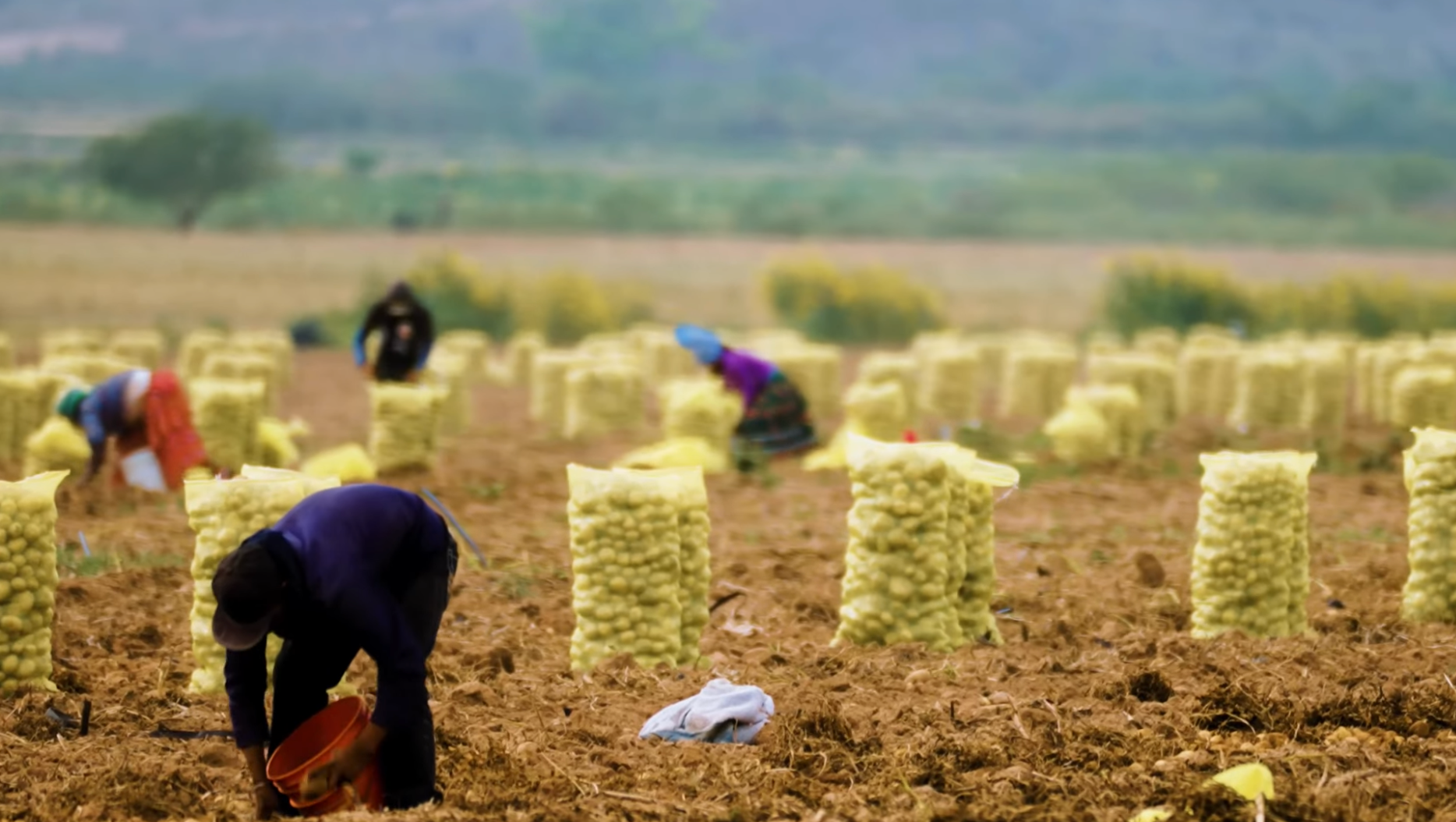
On its own, that sounds like a machinery-efficiency comparison.
In farming, however, the implications can be different.
Crop-protection applications happen within limited windows. Wind conditions change. Rain arrives. Disease and insect pressure continue to develop. Completing an application more quickly can give a grower more flexibility within the available window.
The Mexican case also discusses reduced crop damage because equipment does not need to travel through the crop, less direct operator exposure to the treated area, and cost advantages under the conditions of that particular operation.
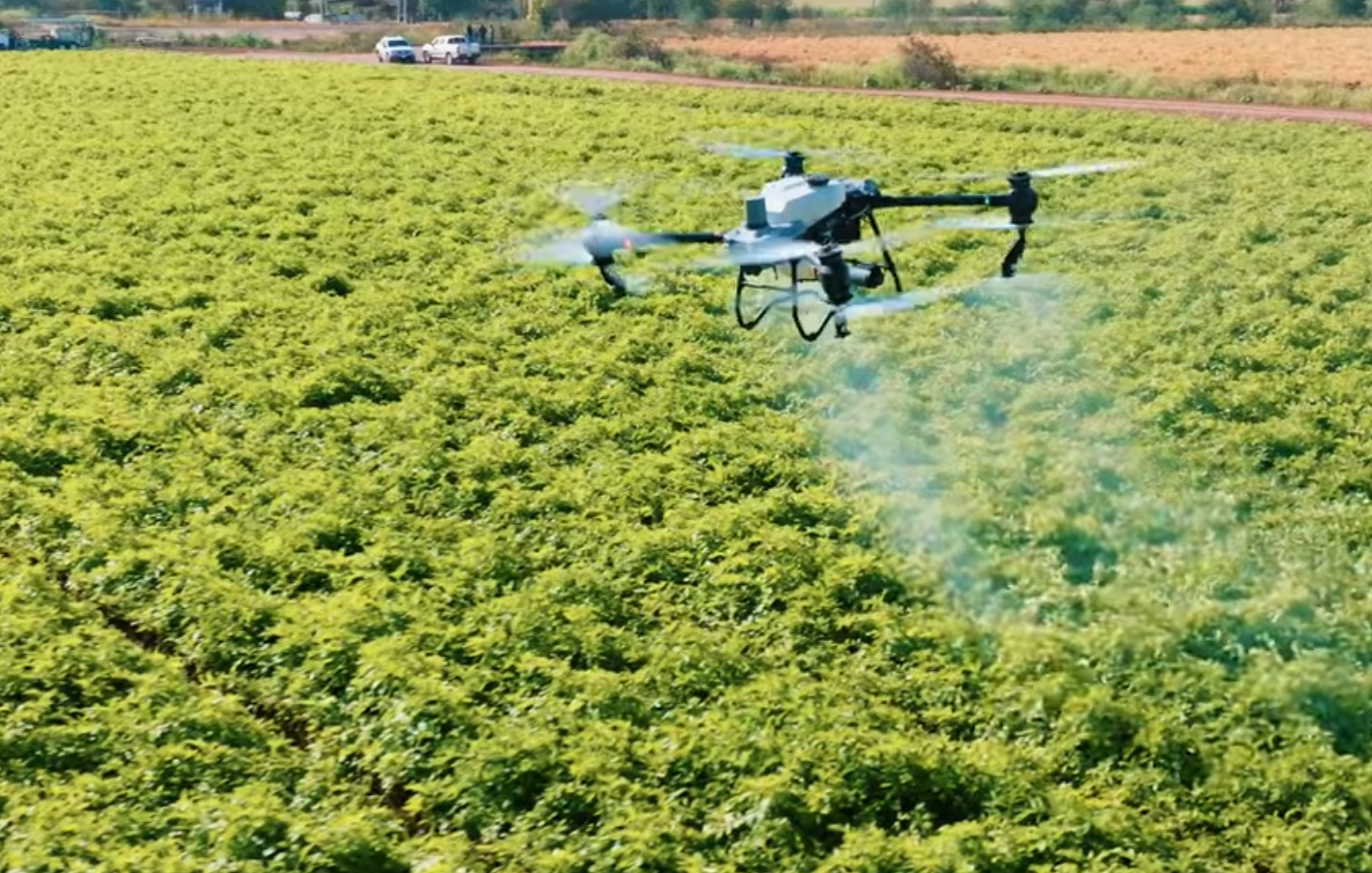
But the case reinforces a broader point: changing how an application gets into the field can change not only the spraying itself, but also the time, labour and equipment required to complete the job.
Those results should not automatically be transferred to Canadian farms. Labour costs, equipment costs, farm size and existing application systems are different.
So Where Does a Drone Actually Fit on the Farm?
After looking at these experiences together, we have become less interested in answering whether drones can “replace” ground sprayers.
Real farming is not a competition between machines.
High-clearance ground sprayers are mature, highly productive tools and remain the best choice in many situations. Conventional aerial application has its own advantages in scale and efficiency. Drones have limitations as well, including payload, battery logistics, weather constraints and regulatory requirements.
Growers do not need to pick a side.
If field conditions are good and a ground sprayer can efficiently do the job, use it. If conventional aerial application is the best fit for the job that day, use that.
But if it has just rained, the field cannot support large equipment and the crop-protection window is already open, a drone may become a very useful option to have available.
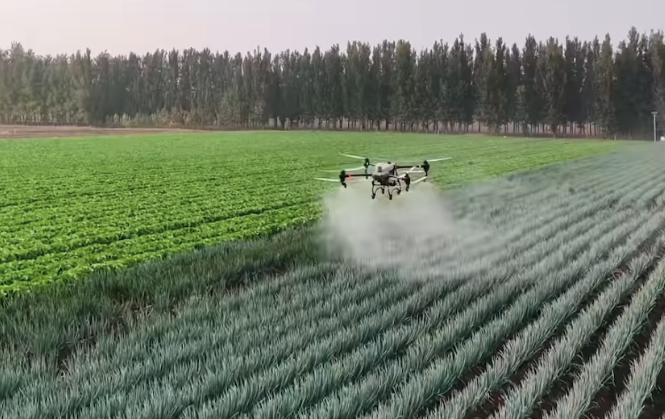
Today, we tend to evaluate that value through three practical questions.
The first is Timeliness: when the crop needs intervention, can the application be completed at the right time?
The second is Application Quality: once the application is made, did the crop-protection product actually reach the areas that needed protection?
The third is Operational Reliability: can the equipment and operator consistently get the job done throughout the season?
That last question is easy to underestimate.
During a busy application season, we once helped a grower troubleshoot problems with a newer-generation agricultural drone. The issue ultimately was not a hardware failure. Some of the operating guidance the grower had previously received was still based on procedures for the previous generation of equipment.
Once the settings and operating process were corrected, the problem was resolved, and the drone system went on to become part of the grower’s regular operation.
That experience changed the way we think about timeliness as well.
It is not only about whether the drone can fly when the ground sprayer cannot.
When the crop needs attention, is the equipment ready? Does the operator know what to do? And if something goes wrong, can the problem be solved quickly enough to keep the application window from closing?
Those are part of timeliness too.
In the End, What Growers Are Trying to Do Hasn’t Changed
The questions growers ask are surprisingly similar.
When will the field be ready after the rain?
What stage is the disease at today?
Did the product actually reach the part of the plant that needed protection?
If I cannot make the application today, will I still have the same opportunity two days from now?
And after harvest, will the crop maintain its quality through storage?
Drones do not make those agricultural problems disappear. Nor do they need to replace every conventional piece of equipment to prove their value.
What they may offer is another capability that growers did not have as easily before: when ground conditions, weather or a narrow application window limit the usual way of doing the job, there may still be an opportunity to intervene in time.
Looking back at that Ontario potato demonstration, what we remember most is not how many acres the drone covered or any particular equipment specification.
It was what happened after the application.
We walked back into the field and pulled the water-sensitive cards, one by one, from deep inside that dense potato canopy.
There were droplets on them.
Because in the end, the grower’s questions are remarkably simple:
When the crop needs it, can I get the job done in time? And when the job is done, did it actually work?
That may be the most practical way to think about where agricultural drones fit in farming today.
Does That Mean Every Farm Should Buy a Spray Drone?
Not every farm needs to own a spray drone. If your ground equipment can consistently make every application within the required window, adding another application system may not provide enough value.
But if wet ground regularly delays applications, if crop damage from ground traffic is a concern, or if you are looking for another way to protect narrow application windows, then the calculation begins to change.
The question is no longer simply what a drone costs.
The question is what a missed application window costs your farm.
Still skeptical? Good. Test it in your own crop.
Put water-sensitive paper at the top, middle and bottom of the canopy. Use the application parameters you’re considering, make a pass, and see the results for yourself.
That’s how we prefer to start the conversation.
If you’re considering where a spray drone might fit into your operation, our team can help you evaluate it under real field conditions. With eight years of experience working with DJI Agriculture, hands-on operator training through Wonderfull Academy, and responsive technical support during the season, our goal isn’t simply to put a drone on your farm. It’s to make sure you can use it effectively when your crop needs it.
Because the real value of a spray drone isn’t owning one. It’s having another option when the crop can’t wait.
WONDERFULL INC.
Transport Canada Recognized RPAS Flight School
Certified Advanced Flight Reviewer
Drone Compliance | Academy Training | Sales & Service
Office: 647-800-7952
Text: 647-287-6851
5955 10 Sideroad
Innisfil, ON L0L 1K0
Canada